Rhizome edge spacing
When planting or dividing, set rhizomes so the growing tips have 5–10 cm of open space in front of them, which lets fronds expand without crowding and reduces the risk of rot where crowns touch.

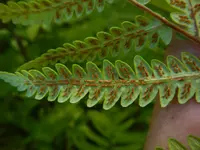
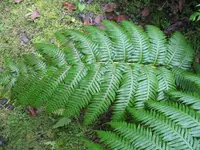
Virginia chainfern, Woodwardia virginica, is a deciduous wetland fern native to eastern North America. It typically forms arching clumps with long, narrow, ladder-like fronds.
This species naturally occurs in bogs, swamps, wet woodlands, and along stream margins, where soils stay consistently moist to wet. Its spreading rhizomes slowly create colonies, giving a soft, textural ground layer.
Virginia chainfern is generally reliable if its need for steady moisture and organically rich, acidic soil is met. It prefers shade to partial shade and does not tolerate drought.
Gardeners who learn how to care for Virginia chainfern usually find it a long-lived, low-maintenance choice for shady rain gardens and naturalized wet areas.

Care Difficulty
Moderate Care

Light Preference
Partial Shade

Water Requirements
Keep Soil Moist

Temperature Preference
Cold Hardy

Hardiness Zone
3–9

Soil Texture
Loamy, Silty, Organic-rich

Soil pH
Strongly acidic (4.5–5.5), Acidic (5.5–6.5)

Soil Drainage
Waterlogged tolerant

Fertilization
Minimal (feed rarely)
Scan your plant to receive care tips personalized for your specific plant
Available on iOS and Android
This wetland fern prefers bright shade with very limited direct sun.
This species naturally grows in boggy, consistently moist to wet soils.
This fern is cold hardy yet prefers mild to warm growing conditions.
This fern needs consistently high humidity to thrive and avoid frond tip damage.
Soil for this species must stay consistently moist and high in organic matter.
This species can be grown in containers if the pot is managed to stay evenly moist and cool.
This moisture-loving native fern needs only light feeding in cultivation, as it is adapted to low-nutrient wet soils.
Pruning Woodwardia virginica is mainly a matter of cleaning and tidying rather than shaping.
This fern is usually grown in the ground in wet sites, so focus on careful transplanting rather than frequent repotting.
Woodwardia virginica is commonly propagated by division, which keeps clonal plants true to type.
This fern is cold hardy in much of its native range and usually needs only minimal winter attention outdoors.

Plant Health Check
Not sure what's wrong with your plant? Check your plant's health inside the app.
This fern is strongly associated with acidic, nutrient-poor wetlands such as bogs, pocosins, and wet pine barrens along the eastern North American coastal plain, where it often forms extensive colonies in saturated peat or muck soils.
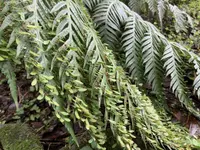
The common name Virginia chainfern refers to the beaded or chainlike pattern formed by its linear sori (spore-bearing structures) on the undersides of the fronds, which appear in distinct rows along the leaf segments.
Populations in coastal plain ecosystems can persist under periodic fire and flooding, resprouting from protected rhizomes after aboveground fronds are damaged or destroyed.

Virginia chainfern is considered an indicator species for certain acidic coastal plain wetlands, so its presence is often used by ecologists and wetland scientists to help identify and classify specific wetland habitat types.
Brown fronds usually come from drought stress, low humidity, excess sun, or fertilizer burn. Keep soil consistently moist, increase humidity, and avoid direct harsh sun. Trim fully dead fronds to reduce stress and encourage fresh growth.
Keep your plants happy and healthy with plant identification, disease detection, and easy care guidance.