Support hybrid structure
Install discreet stakes or a small trellis early, then loosely tie new shoots with soft garden ties to keep the hybrid’s often uneven, crossing stems upright and reduce stress at the graft union.

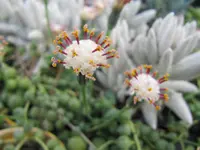
× Bacurio is a cultivated hybrid, often grown as an ornamental plant for its structured form and attractive foliage. It usually has a compact, well-branched habit suited to containers or small garden spaces.
In gardens and indoor collections, × Bacurio is chosen for its steady growth and relatively predictable size. It is typically adapted to mild, temperate conditions and prefers stable, moderate environments rather than extremes.
Most selections respond best to bright, indirect light, evenly moist but not waterlogged soil, and good air movement. These traits make it moderately easy for enthusiasts who understand how to care for × Bacurio and can provide consistent conditions.

Care Difficulty
Moderate Care

Light Preference
Partial Shade

Water Requirements
Moderate Water

Temperature Preference
Warm Climate

Hardiness Zone
Unknown

Soil Texture
Loamy

Soil pH
Slightly acidic (6.5–7.0)

Soil Drainage
Well-drained

Fertilization
Minimal (feed rarely)
Scan your plant to receive care tips personalized for your specific plant
Available on iOS and Android
This hybrid prefers bright, gentle light that mimics open woodland edges.
Moist but not saturated soil supports healthy root development for this hybrid.
Stable, mild temperatures keep this hybrid growing steadily through the active season.
This plant prefers moderately moist air and reacts if conditions become too dry for long periods.
This hybrid performs best in a loose, airy mix that drains quickly but retains some consistent moisture.
This species is suitable for container growing when the pot is chosen to support its root pattern and top growth.
This guidance assumes × Bacurio is grown as a garden or container ornamental that benefits from moderate feeding.
Pruning × Bacurio helps maintain a stable framework and encourages healthy new growth.
Transplanting or repotting × Bacurio should focus on limiting root disturbance while refreshing the root zone.
Propagation of × Bacurio is usually done by semi-hardwood or hardwood cuttings under controlled conditions.
Winter care for × Bacurio depends on local climate and whether it is container-grown or planted in the ground.

Plant Health Check
Not sure what's wrong with your plant? Check your plant's health inside the app.
The multiplication sign in × Bacurio indicates it is a formally recognized hybrid, not a naturally occurring species, following the rules of the International Code of Nomenclature for algae, fungi, and plants. This tells botanists that Bacurio results from a cross between two distinct parent taxa, even if those parents are not stated in the shorthand name.
The prefix × in front of Bacurio signals that it is treated as a nothospecies, a hybrid given species rank. This status is only applied when a hybrid is stable and distinct enough in its features to be consistently recognized and named.
Because it is a named hybrid, Bacurio is expected to show a repeatable combination of traits inherited from its parental lines, such as growth form, leaf structure, or flowering behavior. This consistency is important in horticulture, where breeders and growers rely on predictable characteristics when propagating plants for cultivation.
Lack of blooms often results from insufficient light, heavy pruning at the wrong time, or nutrient imbalance, especially excess nitrogen. Check light exposure, avoid cutting new buds, and use a balanced, low-nitrogen fertilizer if needed.
Keep your plants happy and healthy with plant identification, disease detection, and easy care guidance.