Rotate For Symmetry
Rotate the pot 90° every 2–3 weeks so all sides receive similar light, which keeps the dolphin-shaped leaves evenly spaced and prevents one-sided, sparse growth.

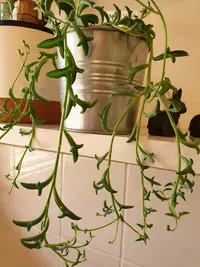
String of dolphins, × Bacurio delphinatifolius, is a trailing succulent known for its small, curved leaves that resemble leaping dolphins. It forms long, hanging stems that suit shelves, hanging baskets, and high planters.
This hybrid likely involves South African succulent parents, so it prefers bright, dry conditions and stores water in its leaves. It usually grows slowly and stays compact indoors, which makes it suitable for small spaces.
Overall, it is considered moderate in difficulty, mainly because it is sensitive to overwatering and low light. Those who learn how to care for String of Dolphins often find it a long-lived and rewarding houseplant.

Care Difficulty
Moderate Care

Light Preference
Partial Sun

Water Requirements
Moderate Water

Temperature Preference
Warm Climate

Hardiness Zone
Unknown

Soil Texture
Sandy, Loamy, Rocky

Soil pH
Acidic (5.5–6.5), Slightly acidic (6.5–7.0)

Soil Drainage
Well-drained

Fertilization
Minimal (feed rarely)
Scan your plant to receive care tips personalized for your specific plant
Available on iOS and Android
This succulent hybrid prefers bright, indirect light that mimics open, airy habitats.
This plant stores water in its leaves and needs infrequent, careful watering.
This succulent grows best in warm, stable conditions without frost exposure.
This succulent handles typical indoor humidity and rarely needs special adjustments.
This plant needs a sharply draining, airy mix that dries quickly between waterings.
This species is well suited to container growing due to its compact, trailing habit.
This hybrid succulent, often sold as String of Dolphins, benefits from light feeding during its active growing season.
Pruning × Bacurio delphinatifolius keeps the trailing stems compact and promotes denser growth.
This plant prefers slightly snug containers and only needs repotting when growth or roots become constrained.
Propagation of × Bacurio delphinatifolius is commonly done from stem cuttings taken during the warm growing season.
This succulent hybrid is not very frost tolerant and benefits from mindful winter care, especially in cool climates.

Plant Health Check
Not sure what's wrong with your plant? Check your plant's health inside the app.
This plant is a bigeneric hybrid between Curio rowleyanus and Curio articulatus, which gives it the distinctive dolphin-shaped leaves that appear to be jumping along the trailing stems. The curved leaf with a pointed tip and small notch resembles a leaping dolphin more closely than either parent species.
Like its parent species from arid regions of southern Africa, this hybrid stores water in its succulent leaves and stems, allowing it to tolerate dry spells better than many ornamental houseplants. The small translucent window on the upper side of some leaves helps light penetrate deeper into the tissue to support photosynthesis while minimizing water loss.
The species forms long, cascading stems that can easily reach hanging basket length under good light. In habitat-inspired conditions, the plant uses this trailing habit to spread over rocks or down slopes, maximizing light exposure while keeping its roots in relatively cool, shaded substrate.
Brown tips or patches usually result from underwatering, very low humidity, or fertilizer/salt buildup in the soil. Check moisture with your finger, flush the pot occasionally, and avoid placing the plant too close to hot, dry air sources.
Keep your plants happy and healthy with plant identification, disease detection, and easy care guidance.