capote Care (Xanthosoma robustum)

Also known as: elephant ear
capote

About capote

Capote, Xanthosoma robustum, is a large tropical aroid grown mainly for its bold, architectural foliage. It forms tall clumps with thick stems and huge, arrow-shaped leaves that create a strong jungle look indoors or in warm outdoor gardens.

This species comes from humid tropical regions of Central and South America, where it grows in bright shade at forest edges and along moist slopes. Its fast growth, high moisture needs, and large mature size mean it suits growers who have some space and can provide consistent care for capote.

It generally prefers bright, filtered light, warm temperatures, and evenly moist, well-drained soil with good organic matter content.

Main Plant Requirements

Care Difficulty

Moderate Care

Light Preference

Partial Shade

Water Requirements

Keep Soil Moist

Temperature Preference

Tropical / Frost Sensitive

Hardiness Zone

10–12

Soil Texture

Loamy, Silty, Organic-rich

Soil pH

Acidic (5.5–6.5), Slightly acidic (6.5–7.0)

Soil Drainage

Moist but well-drained

Fertilization

Moderate (every 2–4 weeks)

Get Personalized Care Plan

Scan your plant to receive care tips personalized for your specific plant

Available on iOS and Android

How to Care for the capote

This large aroid prefers bright, filtered light that mimics understory forest conditions.

  • Provide 4–6 hours of bright, indirect light daily; morning sun is acceptable if filtered through sheer curtains or light canopy shade.
  • Tolerates partial shade, but in very low light leaves may elongate, lose vigor, and show reduced size; rotate plants for even exposure when caring for capote.
  • Avoid harsh midday sun, which can cause yellow or brown scorch patches; in summer, move to dappled shade or use 30–50% shade cloth outdoors.

This species needs steadily moist but not waterlogged soil to maintain healthy foliage and roots.

  • Water when the top 3–5 cm of soil feels dry, soaking the root zone thoroughly, then let excess drain away to prevent root rot.
  • In spring and summer, expect faster drying and more frequent watering; in fall and winter, allow slightly deeper drying and reduce frequency as growth slows.
  • Watch leaves for cues: drooping, thin leaves and very dry soil suggest underwatering, while yellowing lower leaves, a sour smell, or mushy petioles indicate excess moisture for Xanthosoma robustum.

This tropical plant thrives in consistently warm, frost-free conditions throughout the growing season.

  • Ideal growth occurs at 70–85°F (21–29°C), supporting large leaf production and strong roots, especially during the active spring–summer period.
  • Protect from cold; growth slows under 60°F (16°C) and tissue damage can occur below 50°F (10°C), with frost likely killing exposed foliage.
  • Tolerates short heat waves up to about 90–95°F (32–35°C) if soil stays evenly moist and humidity is moderate; provide shade and avoid hot, drying winds in extreme heat.

This species prefers consistently high humidity to support its large leaves and lush growth.

  • Aim for 60–80% humidity; growth slows and leaf edges crisp in prolonged dry indoor air below about 40%.
  • Watch for brown, curling leaf margins and stalled new leaves as early signs of humidity stress in capote.
  • Increase humidity with a room humidifier, grouped plants, or a wide pebble tray, but avoid misting that keeps leaves wet for hours.

Prepare a loose, airy, organic-rich substrate that holds moisture yet drains quickly for Xanthosoma robustum.

  • Use a mix such as 50% peat or coco coir, 25% fine bark, and 25% perlite or pumice to balance moisture retention and aeration.
  • Ensure water drains freely through the mix within seconds, with no water pooling on the surface or collecting in the saucer.
  • Keep pH slightly acidic to neutral (pH 6.0–7.0), which supports nutrient uptake and prevents micronutrient lockout.
  • Avoid heavy garden soil, pure compost, or mixes dominated by fine peat that compact, exclude oxygen, and encourage root rot.

This species is suitable for container growing when the pot is chosen to support its vigorous, top-heavy habit.

  • Select a wide, heavy container that resists tipping as foliage enlarges and catches wind on balconies or patios.
  • Choose a deep pot that allows thick, tuberous roots to expand downward without circling tightly against the walls.
  • Use a slightly moisture-retentive mix in nonporous pots and a more free-draining mix in terracotta to balance evaporation.

Xanthosoma robustum responds well to moderate, consistent nutrition during the warm growing season.

  • Use a balanced liquid fertilizer (such as 10-10-10 or 20-20-20) at 1/2 strength every 3–4 weeks in spring and summer.
  • Alternatively, apply a slow-release granular fertilizer at the start of the growing season, following label rates.
  • Supplement with a thin layer of well-rotted compost over the root zone once per year when caring for capote.
  • Reduce feeding to once every 6–8 weeks in fall and stop fertilizing in winter dormancy.

Pruning Xanthosoma robustum focuses on cleanliness and managing size rather than shaping.

  • Best time for pruning is late winter to early spring, just before active growth resumes.
  • Remove yellowing, dead, or damaged leaves at the base using clean, sharp pruners or scissors.
  • Thin out crowded or inward-facing leaves to improve airflow and reduce fungal problems.
  • Light pruning helps maintain a balanced canopy and directs energy into producing vigorous new foliage.

Container-grown plants benefit from occasional transplanting to maintain strong root health.

  • Check for roots circling the pot, growing from drainage holes, or stunted foliage as signals to move the plant.
  • Plan repotting or outdoor transplanting in late spring, once temperatures stay consistently above 60°F.
  • Repot every 2–3 years into a container 2–5 cm wider, using a loose, well-draining, rich mix.
  • Handle roots gently, keep the root ball slightly intact, water thoroughly afterward, and shade for 3–5 days to limit stress.

Propagation of Xanthosoma robustum is usually done by division of the underground tubers or clumps.

  • Carry out division in late spring or early summer when growth is active and temperatures are warm.
  • Lift the clump, then separate tubers or offsets ensuring each division has at least 1–2 healthy buds and roots.
  • Plant divisions into moist, well-draining soil, keeping them at the same depth as before.
  • Maintain 70–80°F, bright indirect light, and evenly moist conditions to encourage quick establishment.

This tropical species is frost-sensitive and needs thoughtful winter care in cooler climates.

  • In regions below USDA zone 10, grow in containers or dig tubers before the first hard frost.
  • Mulch the root zone with 5–8 cm of straw, leaves, or bark in mild-winter areas to buffer temperature swings.
  • Move pots indoors to a bright, cool, frost-free room and reduce watering during winter dormancy.
  • If lifting tubers, clean, dry slightly, then store in barely moist peat or vermiculite at 50–60°F.

Care Tips

Provide sturdy support

Install a strong stake or short trellis early and loosely tie the thick petioles with soft ties so the heavy leaves do not snap or lean and the root system stays stable as the plant matures.

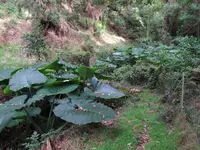
Use wide, heavy pots

Choose a low, wide, and relatively heavy container to prevent tipping from the large canopy and to give the spreading rhizomes space to expand without becoming rootbound too quickly.

Rotate for balanced growth

Turn the pot 90° every 1–2 weeks so new leaves distribute evenly around the plant, reducing the risk of lopsided growth and mechanical stress on a single side of the root base.

Inspect petioles and undersides

Check the undersides of leaves and along the petioles every 1–2 weeks for early signs of spider mites, aphids, or scale, and wash with a strong but gentle stream of water at the first sign of pests to avoid chemical treatments when possible.

Seasonal light adjustment

In late winter and early spring move the plant slightly closer to its brightest window or supplement with a grow light for 8–10 hours to support strong new leaf production when days are short, which is especially helpful when growing capote indoors.

Common Pests and Diseases

Aroid leaf spot

This disease causes tan to dark brown spots with yellow halos on foliage, often starting on older leaves in warm, humid conditions. Symptoms include irregular lesions that may coalesce, leading to large dead patches and premature leaf drop.

Solution

Remove and discard affected leaves, keep foliage as dry as possible, and improve air movement around the plant by spacing and pruning. Avoid overhead watering, clean tools and pots regularly, and, in severe or recurring cases, use a copper-based fungicide labeled for aroids, following label directions carefully.

Bacterial blight

This disease produces water-soaked, translucent lesions that turn dark and may ooze, often spreading quickly in warm, wet conditions. Symptoms include leaf deformation, marginal necrosis, and a foul smell on heavily affected tissue.

Solution

Promptly remove and dispose of all infected leaves and plant debris, and avoid splashing water on foliage during irrigation. Disinfect tools between cuts, reduce humidity and crowding, and discard severely affected plants, as chemical control for bacterial issues in home settings is limited.

Spider mites

These pests cause fine stippling, dulling, and eventual bronzing of leaves, often accompanied by delicate webbing, especially on the undersides. This pest thrives in warm, dry indoor air and can weaken the plant over time if not controlled.

Solution

Wash leaves thoroughly, especially undersides, with a strong but gentle stream of lukewarm water, then increase humidity around the plant and reduce heat stress. For persistent infestations, apply insecticidal soap or horticultural oil to all leaf surfaces at 7–10 day intervals, ensuring repeated coverage of new growth and leaf undersides.

Mealybugs

These insects appear as white, cottony clusters in leaf axils, along stems, and sometimes on roots, feeding on sap and causing yellowing and leaf distortion. This pest also excretes honeydew, which can lead to sooty mold on leaves and nearby surfaces.

Solution

Isolate the plant, then dab visible insects with cotton swabs dipped in isopropyl alcohol and wipe down infested areas. Follow up with applications of insecticidal soap or neem oil every 7–10 days until no new mealybugs are seen, and inspect any new plants before placing them nearby.

Dasheen mosaic virus

This disease causes mottled, streaked, or mosaic patterns on leaves, often with distorted or narrowed blades and reduced vigor over time. Symptoms include uneven coloration between veins and possible stunting of new growth.

Solution

Remove and destroy severely symptomatic plants, as there is no cure for viral infections, and avoid propagating from affected material. Control sap-sucking insects such as aphids that spread the virus, sterilize cutting tools between plants, and source new plants from reputable suppliers to reduce infection risk when trying to grow Xanthosoma robustum.

Interesting Facts

Massive elephant-ear leaves

This species develops very large sagittate (arrow-shaped) leaves that can exceed 1 m in length in suitable tropical conditions, giving it a strong architectural presence in the landscape.

Robust pseudostem structure

The apparent trunk is not true woody tissue but a pseudostem formed by tightly packed leaf bases, which allows the plant to reach considerable height yet remain herbaceous.

Moist-forest native

It is native to humid tropical forests of Central and northern South America, where it typically occupies partially shaded, consistently moist habitats along forest edges and clearings.

Botan icon

Did you know?

In mature specimens, the inflorescences are typical aroid structures with a spadix surrounded by a spathe, and in natural habitats these are visited by specialized insects that use the inflorescences as shelter, aiding pollination in the process.

FAQs about capote

Brown leaf edges usually come from low humidity, salt buildup, or fertilizer burn. Entire brown leaves often indicate root problems or prolonged dryness. Trim damaged parts, flush the soil, and stabilize moisture and humidity levels.

Grow Healthy Plants with Botan Care

Keep your plants happy and healthy with plant identification, disease detection, and easy care guidance.


Botan plant care app — identify plants on mobile

Explore More Plants