Stabilize Heavy Petioles
Install sturdy stakes or a low plant support ring early in the season and loosely tie heavy petioles so large leaves do not snap under their own weight or in indoor air currents.

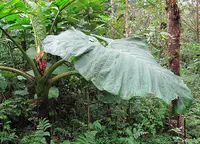
Tall elephant's ear (Xanthosoma undipes) is a tropical aroid grown for its large, upright, arrow-shaped leaves and bold, architectural form. It is typically grown as an ornamental foliage plant in gardens or large containers, creating a lush, jungle-like effect. Native to tropical regions of the Americas, it thrives in warm, humid environments with consistently moist but not waterlogged soil. This species grows quickly under stable conditions but can be sensitive to cold, low humidity, and prolonged dryness, which makes it better suited to mild or indoor climates. Understanding how to care for tall elephant's ear usually makes it manageable for intermediate plant owners looking for a statement plant.

Care Difficulty
Moderate Care

Light Preference
Partial Shade

Water Requirements
Keep Soil Moist

Temperature Preference
Tropical / Frost Sensitive

Hardiness Zone
10–12

Soil Texture
Loamy, Silty, Organic-rich

Soil pH
Acidic (5.5–6.5), Slightly acidic (6.5–7.0)

Soil Drainage
Moist but well-drained

Fertilization
Moderate (every 2–4 weeks)
Scan your plant to receive care tips personalized for your specific plant
Available on iOS and Android
Xanthosoma undipes prefers bright, indirect light that mimics dappled tropical shade.
This species thrives in consistently moist but not stagnant soil.
This plant performs best in warm, frost-free conditions with stable temperatures.
This species prefers consistently humid air and reacts quickly to dry indoor conditions.
This aroid prefers loose, airy, organic-rich soil that stays evenly moist but never waterlogged.
This species grows well in large containers when its size, weight, and moisture needs are planned for.
Xanthosoma undipes responds well to moderate feeding during active growth but does not need heavy fertilization.
Pruning Xanthosoma undipes is mainly hygienic and helps maintain a tidy, healthy clump.
Container-grown Xanthosoma undipes benefits from occasional repotting to support strong root and leaf growth.
Xanthosoma undipes is most reliably propagated by division of tubers or clumps rather than by seed.
Xanthosoma undipes is frost-sensitive and needs thoughtful winter care in climates with freezing temperatures.

Plant Health Check
Not sure what's wrong with your plant? Check your plant's health inside the app.
In parts of tropical America, this species is traditionally cultivated for its starchy underground corms, which are cooked similarly to other aroid staples after thorough heating to destroy natural irritant compounds.
The plant is native to humid lowland areas of northern South America and Central America, where it grows in rich, often periodically wet soils along forest edges and disturbed sites.
It produces broad, sagittate (arrow-shaped) leaves adapted to capture limited light under taller vegetation, which is why it performs well in bright shade rather than in exposed, intense sun.
Brown edges usually come from low humidity, excess fertilizer salts, or inconsistent moisture rather than pests. Flush the soil, keep the potting mix evenly moist, increase humidity slightly, and avoid direct contact with hot or cold drafts.
Keep your plants happy and healthy with plant identification, disease detection, and easy care guidance.