

Use Decaying Conifers
Establish colonies on well-rotted conifer wood or thick conifer litter rather than generic compost, as this fungus specializes in decomposing resinous substrates and will fruit more reliably there.

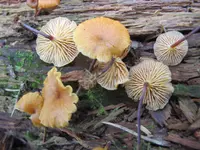
Pinelitter gingertail, Xeromphalina cauticinalis, is a small woodland fungus rather than a leafy plant. It forms clusters of tiny orange to reddish-brown caps on thin stems. These fruiting bodies often appear on decaying conifer litter, charred wood, or very well-rotted stumps in cool, moist forests of North America and Europe.
The species thrives in damp, shaded conditions where organic debris is abundant. Its delicate size and specific substrate needs make it interesting to observe but not very practical for casual cultivation. Enthusiasts who want to learn how to care for pinelitter gingertail usually focus on replicating its natural forest floor habitat in controlled, experimental setups.

Care Difficulty
Moderate Care

Light Preference
Partial Shade

Water Requirements
Keep Soil Moist

Temperature Preference
Cool Climate

Hardiness Zone
Unknown

Soil Texture
Loamy, Organic-rich

Soil pH
Acidic (5.5–6.5)

Soil Drainage
Moist but well-drained

Fertilization
Minimal (feed rarely)
Scan your plant to receive care tips personalized for your specific plant
Available on iOS and Android
This small woodland fungus prefers soft, filtered light rather than direct, open sun.
Moist, well-aerated forest litter is essential for this fungus, which relies on consistently damp but not saturated conditions.
This species thrives in cool to mild conditions typical of shaded conifer woods.
This fungus does not need controlled humidity and generally tolerates typical outdoor fluctuations.
This fungus fruits on decaying conifer litter rather than in standard potting soil, so conditions must mimic a loose forest floor.
This species is not suitable for typical container growing and is rarely maintained long-term in pots.
This small saprotrophic fungus usually needs no fertilizer when grown in naturally decomposing conifer litter as pinelitter gingertail.
Xeromphalina cauticinalis does not require pruning, since individual fruiting bodies are short-lived and replaced naturally.
Transplanting focuses on maintaining a suitable decaying wood or conifer-litter substrate rather than moving individual Xeromphalina cauticinalis clusters.
Propagation of Xeromphalina cauticinalis is mainly a matter of spreading its mycelium through suitable habitat rather than using typical garden techniques.
This woodland fungus is naturally cold hardy in its native range and generally needs no special winter care in outdoor settings.

Plant Health Check
Not sure what's wrong with your plant? Check your plant's health inside the app.
This species is strongly associated with charred wood and often fruits in dense clusters on burned conifer logs or stumps after forest fires, making it a classic post-fire fungus in boreal and montane forests.
The mushrooms are very small, with thin orange-brown caps and long dark stems, but they frequently appear in tight, tufted clusters that can cover large areas of decaying wood and make them more visible in the field.
Fresh fruitbodies are noted for a distinctive resinous or tar-like odor, which mycologists use as an important field character to separate it from other similar small brown mushrooms on wood.
This fungus is not suited to typical indoor culture. It grows best outdoors on decaying conifer litter in cool, moist, shaded forest conditions. Attempts at pinelitter gingertail indoor care usually fail without tightly controlled humidity, airflow, and substrate.
Keep your plants happy and healthy with plant identification, disease detection, and easy care guidance.

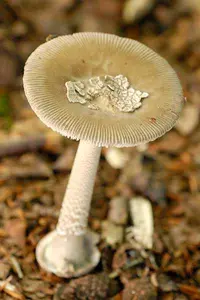
Peeling Paint Ringless Amanita
Amanita submembranacea
Yellow Patches
Amanita flavoconia
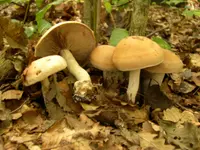
bitter poisonpie
Hebeloma sinapizans
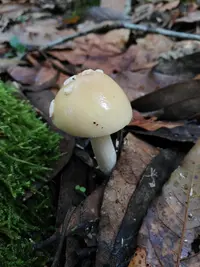
Cottony Volva Amanita
Amanita xylinivolva
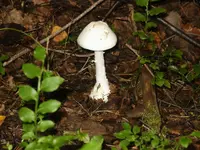
European destroying angel
Amanita virosa
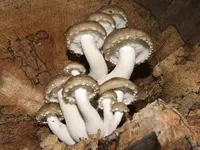
Elm Mushroom
Hypsizygus ulmarius
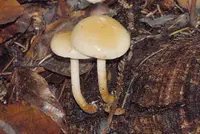
pale poisonpie
Hebeloma leucosarx
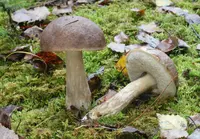
greyshank bolete
Leccinum cyaneobasileucum