

Deep root training
In the first 2–3 years, water less often but very deeply to encourage a deep taproot, which improves drought tolerance and long‑term stability when growing sandplain woody pear in exposed sites.


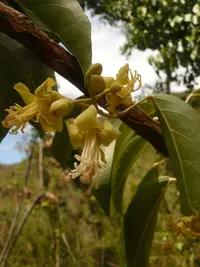
Sandplain woody pear, Xylomelum angustifolium, is a woody shrub or small tree from the dry regions of Western Australia. It belongs to the Proteaceae family and is known for its hard, pear-shaped seed pods and narrow, leathery leaves.
Plants usually grow with a sparse, upright habit and a somewhat rugged appearance, adapted to nutrient-poor, sandy soils. Its deep root system and tough foliage reflect its origin in fire-prone, low-rainfall habitats.
These same adaptations make it drought-tolerant but slow-growing, and it resents disturbance to its roots, which can make it challenging to establish in cultivation. Those who want to learn how to care for sandplain woody pear should provide very well-drained soil, good sun, and avoid overwatering.

Care Difficulty
Moderate Care

Light Preference
Full Sun

Water Requirements
Low Water

Temperature Preference
Warm Climate

Hardiness Zone
9–11

Soil Texture
Sandy, Loamy, Rocky

Soil pH
Acidic (5.5–6.5), Slightly acidic (6.5–7.0)

Soil Drainage
Well-drained

Fertilization
Minimal (feed rarely)
Scan your plant to receive care tips personalized for your specific plant
Available on iOS and Android
This sun-loving Australian shrub performs best in bright, open sites with strong light exposure.
This species prefers deep, infrequent watering and well-drained, sandy or gravelly soil.
This shrub is adapted to warm, dry climates and needs protection from hard frost.
This species is highly tolerant of dry air and usually does not need special humidity management.
This species prefers very well-drained, sandy soil that mimics its native, nutrient-poor habitats.
This species can be grown in containers, mainly when young, if drainage and stability are carefully managed.
Xylomelum angustifolium is adapted to low-nutrient soils, so use fertilizer sparingly for container or landscape specimens.
Pruning Xylomelum angustifolium is mainly corrective, aimed at maintaining structure and plant health.
This species is usually grown in the ground; transplanting young plants carefully is more important than long-term repotting.
Propagation of Xylomelum angustifolium is most reliably done from seed under controlled conditions.
Xylomelum angustifolium is suited to mild, frost-free or light-frost climates and is not reliably hardy in very cold winters.

Plant Health Check
Not sure what's wrong with your plant? Check your plant's health inside the app.
This species develops large, hard, pear-shaped seed pods that resemble wooden fruit and can persist on the plant for a long time after maturing.
It belongs to the Proteaceae family, sharing traits such as tough, leathery leaves and specialized inflorescences adapted to nutrient-poor, sandy soils in southwestern Australia.
The thick, woody follicles protect seeds from heat, and many are only released after exposure to fire, allowing regeneration in post-fire environments where competition is reduced.

The species is endemic to Western Australia, where it forms part of specialized sandplain shrubland communities and contributes to habitat structure and food resources for local birds and insects adapted to these nutrient-poor landscapes.
Growth is moderately slow. Young plants may add 15–30 cm per year under good conditions, then slow further with age. Poor, dry soils or excessive pruning reduce growth, while deep, well-drained sandy soil supports better extension.
Keep your plants happy and healthy with plant identification, disease detection, and easy care guidance.