Stable host selection
Attach the lichen only to long-lived, stable bark or rock surfaces that will not be disturbed by pruning, construction, or frequent handling, since Xylopsora friesii depends entirely on that substrate for long-term survival.

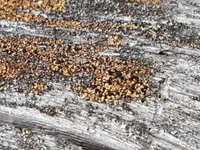
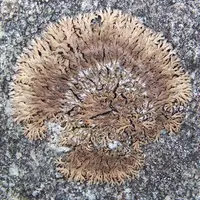
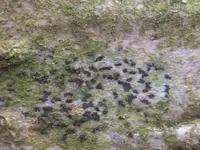
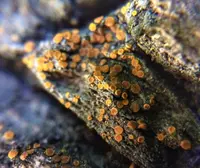
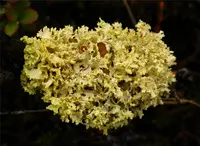
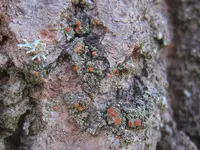
Old-growth clam lichen, Xylopsora friesii, is a crustose lichen that forms thin, shell-like patches tightly attached to bark or rock. Its surface often appears pale gray to brown with a slightly rough texture.
This species is typically found in cool, moist forests, especially in older, relatively undisturbed woodland habitats in the Northern Hemisphere. It grows slowly and depends on stable, clean air conditions, which makes it sensitive and not easy to cultivate.
For those exploring how to care for Old-Growth Clam Lichen, conditions must mimic its natural habitat, with gentle light, steady moisture in the air, and a stable, well-ventilated surface to colonize.

Care Difficulty
Hard Care

Light Preference
Partial Shade

Water Requirements
Low Water

Temperature Preference
Cold Hardy

Hardiness Zone
Unknown

Soil Texture
Rocky, Loamy

Soil pH
Strongly acidic (4.5–5.5)

Soil Drainage
Well-drained

Fertilization
Minimal (feed rarely)
Scan your plant to receive care tips personalized for your specific plant
Available on iOS and Android
This crustose lichen prefers cool, stable, indirect light typical of shaded old-growth forests.
This lichen absorbs moisture from rain, fog, and humidity rather than from deep soil water reserves.
This species is adapted to cool, temperate conditions and tolerates a fairly wide outdoor temperature range.
This lichen prefers consistently cool, moist air and reacts quickly to very dry conditions.
Xylopsora friesii grows on bark or rock rather than true soil, so focus on a firm, stable, low-nutrient surface.
This species can be maintained in containers only as a mounted lichen rather than a rooted plant.
Xylopsora friesii is a lichen that gains nutrients from rain, dust, and its substrate, so it does not require intentional fertilization in cultivation or habitat.
Xylopsora friesii does not respond well to conventional pruning and usually requires no intentional cutting in cultivation or habitat.
This lichen is typically grown on bark or stone rather than in pots, so focus on gentle transplanting instead of classic repotting.
In cultivation, Xylopsora friesii is rarely propagated intentionally because it depends on stable, clean-air habitats and slow natural spread.
Old-Growth Clam Lichen is naturally cold hardy in its native range and generally needs no special winter care once established outdoors.

Plant Health Check
Not sure what's wrong with your plant? Check your plant's health inside the app.
This lichen is strongly associated with long-continuity, cool, moist coniferous forests and is often used as an indicator that a stand has old-growth characteristics and limited recent disturbance.
It forms small, tightly attached, shell- or clam-shaped lobes with a pale to gray-brown upper surface and a blackish underside, which makes it easier for lichenologists to distinguish from many crust-like bark lichens on spruce or fir.
The species occurs mainly on the bark of conifers such as spruce and fir in boreal and montane regions of the Northern Hemisphere, reflecting an adaptation to cool climates and relatively stable bark microhabitats.
This crustose lichen is effectively evergreen, since its thallus remains present and functional year-round. Color and vigor may fluctuate with moisture and temperature, but it does not shed and regrow foliage in a seasonal cycle like vascular plants.
Keep your plants happy and healthy with plant identification, disease detection, and easy care guidance.