Strategic plant placement
Site plants away from livestock areas, vegetable beds, and children’s play zones, and clearly label the planting since all parts of white snakeroot are toxic if eaten.

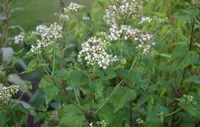
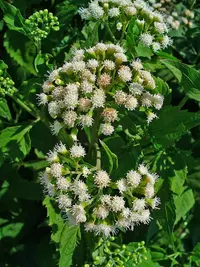
White snakeroot, Ageratina altissima, is a shade-tolerant perennial native to woodlands and forest edges in eastern and central North America. It forms upright clumps with smooth stems and opposite, heart-shaped leaves.
In late summer to fall it carries flat-topped clusters of small, fuzzy white flowers that attract many pollinators. Plants spread slowly by rhizomes and self-seeding, creating loose colonies in suitable sites.
This species adapts to a range of soils but prefers moist, well-drained, humus-rich ground and partial shade. Once established, it is fairly resilient, though understanding how to care for white snakeroot helps keep growth controlled and healthy.

Care Difficulty
Easy Care

Light Preference
Partial Shade

Water Requirements
Moderate Water

Temperature Preference
Cold Hardy

Hardiness Zone
3–8

Soil Texture
Loamy, Silty, Organic-rich

Soil pH
Acidic (5.5–6.5), Slightly acidic (6.5–7.0)

Soil Drainage
Moist but well-drained

Fertilization
Minimal (feed rarely)
Scan your plant to receive care tips personalized for your specific plant
Available on iOS and Android
This woodland perennial prefers bright conditions with protection from harsh midday sun.
This species prefers consistently moist but not saturated soil throughout the growing season.
This hardy perennial tolerates a wide outdoor temperature range typical of temperate climates.
This species is adaptable and humidity is rarely a limiting factor outdoors or in typical homes.
Ageratina altissima prefers moist, loose, organic-rich soil that drains freely but does not dry out rapidly.
This species can be grown in containers if the pot is sized and weighted to support tall, leafy stems.
This native perennial usually thrives in average soil and needs only modest feeding when grown in garden beds or containers.
Pruning Ageratina altissima is useful for controlling size, tidying the clump, and supporting healthy flowering.
This species is most often grown in the ground, so care usually focuses on dividing and transplanting clumps rather than frequent repotting.
Ageratina altissima is commonly propagated by division, seeds, or softwood cuttings taken in the growing season.
Established plants are cold hardy in much of the US and generally need minimal winter care in the ground.

Plant Health Check
Not sure what's wrong with your plant? Check your plant's health inside the app.
This species produces tremetol, a complex mixture of toxins that accumulates in the milk and meat of grazing livestock, historically causing a often-fatal condition in humans known as milk sickness in 19th‑century North America.
It thrives in partial shade on forest edges and disturbed woodland soils, often forming dense patches that can outcompete lower-growing native herbs in its native range.
Its small white flower clusters bloom from late summer into fall, providing nectar and pollen for bees, flies, butterflies, and moths when many other herbaceous plants have already finished flowering.

Abraham Lincoln’s mother, Nancy Hanks Lincoln, is widely believed by historians and medical researchers to have died from milk sickness linked to livestock that had grazed on white snakeroot, making this plant unusually prominent in early U.S. medical and frontier history.
All parts of this species are highly toxic if eaten by people, dogs, cats, horses, cattle, and other livestock. Toxins can pass into milk and meat. Avoid ingestion and prevent animals from grazing where it grows.
Keep your plants happy and healthy with plant identification, disease detection, and easy care guidance.