Chinese Evergreen Care (Aglaonema 'Silver Bay')

About Chinese Evergreen

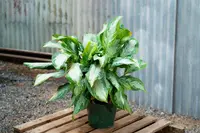
Chinese evergreen Aglaonema 'Silver Bay' is a compact, evergreen foliage plant commonly grown indoors for its patterned leaves. It forms a dense clump of upright stems with broad, silver-green leaves edged in darker green.

This cultivar comes from tropical forest understories in Southeast Asia, where it grows in warm, shaded, and humid conditions. The plant is considered forgiving and suitable for beginners because it tolerates lower light and occasional lapses in watering.

Understanding how to care for Chinese Evergreen mainly involves providing stable indoor temperatures, moderate indirect light, and well-drained potting mix. Its slow to moderate growth and bushy habit make it suitable for desks, side tables, and floor planters.

Main Plant Requirements

Care Difficulty

Easy Care

Light Preference

Bright Indirect Light

Water Requirements

Moderate Water

Temperature Preference

Tropical / Frost Sensitive

Hardiness Zone

11–12

Soil Texture

Loamy, Peaty, Organic-rich

Soil pH

Acidic (5.5–6.5), Slightly acidic (6.5–7.0)

Soil Drainage

Moist but well-drained

Fertilization

Light (every 4–6 weeks)

Get Personalized Care Plan

Scan your plant to receive care tips personalized for your specific plant

Available on iOS and Android

How to Care for the Chinese Evergreen

Aglaonema 'Silver Bay' prefers soft, indirect light that mimics a bright forest understory.

  • Provide bright, filtered light for 6–8 hours daily, such as near a north or east window or behind a sheer curtain with brief gentle morning sun.
  • Plant tolerates partial shade and can grow several feet from a window, but very low light slows growth and produces darker, less variegated Chinese Evergreen leaves.
  • Avoid direct midday or afternoon sun, which can scorch foliage; in winter, move slightly closer to windows to compensate for shorter, weaker light.

This plant prefers evenly moist but not saturated soil that dries slightly between waterings.

  • Water when the top 2–4 cm of soil feels dry; in active growth this may mean roughly once a week, but rely on touch rather than a fixed schedule.
  • Reduce watering in fall and winter as growth slows, allowing the top 4–5 cm to dry to prevent root issues in Aglaonema 'Silver Bay'.
  • Watch for yellowing, mushy stems or a sour smell as signs of overwatering, and drooping, thin, curling leaves as signs the plant has stayed too dry.

Stable, warm temperatures support consistent growth and attractive foliage color.

  • Aim for 65–80°F (18–27°C) for best growth, keeping day and night swings moderate to avoid stress on roots and leaves.
  • Protect the plant from cold; growth slows below about 60°F (16°C) and tissue damage can occur under 50°F (10°C), especially with drafts or sudden chills.
  • In hot spells above 85°F (29°C), increase air movement and check soil more often, avoiding placement near heaters, AC vents, or exterior doors in any season.

This plant prefers moderately humid air but usually adapts to most home conditions.

  • Aim for 40–60% humidity to keep foliage lush and reduce brown tips.
  • It tolerates short periods of dry air, but prolonged low humidity causes crispy leaf edges and dull, curling leaves.
  • Increase humidity with a nearby humidifier, grouping plants, or a pebble tray, especially for Chinese Evergreen in heated or air-conditioned rooms.

This plant grows best in a loose, airy, organic-rich potting medium that drains freely.

  • Use a peat- or coco-coir-based houseplant mix amended with 20–30% perlite for extra drainage and aeration.
  • Include some fine bark chips to create a chunky structure that lets roots breathe and reduces compaction over time.
  • Keep soil slightly acidic to neutral, around pH 6.0–7.0, which supports nutrient uptake and steady growth in Aglaonema 'Silver Bay'.
  • Avoid heavy, clay-like mixes or containers that stay waterlogged, which promote root rot and weak, yellowing foliage.

This species is very suitable for container growing in homes and shaded patios.

  • Choose a stable, slightly wider pot to support its spreading rosette form and prevent tipping as foliage becomes dense.
  • Select pot materials with moderate moisture retention, such as ceramic or plastic, if indoor air is dry or heating is frequent.
  • Ensure drainage holes are unobstructed and empty saucers promptly so the root zone never sits in standing water.

This Chinese Evergreen benefits from light, consistent feeding during the active growing season.

  • Use a balanced liquid fertilizer (such as 10-10-10 or 20-20-20) diluted to 1/4–1/2 strength.
  • Apply every 4–6 weeks in spring and summer, on already moist soil to avoid root burn.
  • Pause feeding in fall and winter when growth slows, unless the plant is under strong artificial light.
  • Slow-release pellets or a thin layer of mature compost can be used in spring for gentle, long-term nutrition.

Pruning helps Aglaonema 'Silver Bay' maintain a compact, tidy shape and encourages fresh foliage.

  • Carry out light pruning in spring or early summer when growth is active.
  • Remove yellowing, dead, or damaged leaves at the base using sharp, clean scissors or pruning shears.
  • Cut back leggy stems just above a node to encourage fuller, bushier growth.
  • Thin crowded shoots to improve airflow and light penetration into the center of the plant.

This plant prefers slightly snug pots and only needs repotting when root bound or growth declines.

  • Check for roots circling the pot, emerging from drainage holes, or soil that dries out very fast as signs to repot.
  • Plan to repot every 2–3 years in spring, moving to a container 2–5 cm wider with drainage holes.
  • Gently loosen circling roots and remove some old soil, keeping the root ball as intact as possible.
  • Water well after repotting, keep in bright, indirect light, and avoid fertilizing for 3–4 weeks to reduce stress.

New plants are most reliably produced by division and stem cuttings.

  • Divide clumps in spring when repotting, ensuring each section has healthy roots and several leaves.
  • For stem cuttings, take 8–12 cm sections with at least 1–2 nodes and remove lower leaves.
  • Root cuttings in moist, well-draining mix at 70–80°F with high humidity and bright, indirect light.
  • Keep the medium slightly moist, not waterlogged, and avoid heavy fertilization until strong new growth appears.

This tropical houseplant is frost sensitive and must be kept in warm indoor conditions during winter.

  • Maintain indoor temperatures around 65–75°F, avoiding drafts and sudden temperature drops.
  • Keep soil slightly drier than in summer, allowing the top 2–3 cm to dry before watering again.
  • Provide bright, indirect light and consider supplemental light if natural daylight is very low.
  • Keep away from cold windows and heating vents that create hot, dry air around the foliage.

Care Tips

Rotate For Symmetry

Turn the pot 90° every 2–3 weeks to keep the foliage dome even and prevent the plant from leaning heavily toward the light source.

Support Heavy Stems

If older stems begin to flop, insert a slim stake near the base and secure stems loosely with soft ties to maintain an upright, compact form without cutting back growth.

Leaf Cleaning Routine

Wipe leaves gently with a damp, soft cloth every 3–4 weeks to remove dust, which improves light capture and allows early detection of pests or leaf spotting.

Low-Stress Repotting

When shifting to a larger pot, keep the root ball mostly intact, only loosening circling roots at the bottom, to minimize transplant shock and maintain steady growth.

Prevent Cold Draft Stress

Place the plant at least 2–3 ft away from exterior doors, single-glazed windows, or winter vents to avoid sudden cold drafts that can cause leaf yellowing and edge burn when growing Chinese Evergreen.

Everything About Chinese Evergreen

Common Pests and Diseases

Mealybugs

This pest appears as white, cottony clusters in leaf axils, along stems, and sometimes on roots, often causing leaf yellowing and stunted growth.

Solution

Isolate the plant, then wipe or dab visible insects with cotton swabs dipped in 70% isopropyl alcohol and rinse the foliage with lukewarm water; repeat weekly until no new pests appear, and consider a targeted insecticidal soap for heavier infestations while monitoring new growth closely as part of ongoing Aglaonema 'Silver Bay' care instructions.

Spider mites

These insects cause fine stippling, dulling of foliage, and delicate webbing, especially on the undersides of leaves, and thrive in warm, dry indoor air.

Solution

Shower the plant with lukewarm water to remove mites, then increase humidity and regularly wipe leaf undersides; use insecticidal soap or a miticide labeled for indoor use if activity remains after several washes and keep the plant away from dry heat sources.

Scale insects

This pest presents as small, brown or tan, shell-like bumps along stems and leaf midribs, often leading to sticky honeydew and sooty mold on leaves.

Solution

Gently scrape or wipe off adults with a soft cloth or toothbrush and treat remaining juveniles with repeated applications of horticultural oil or insecticidal soap, ensuring full coverage of stems and leaf veins while keeping the plant under observation for several weeks.

Bacterial leaf spot

This disease causes water-soaked, translucent or dark lesions on leaves that can enlarge, turn brown, and be surrounded by yellow halos, often spreading in warm, wet conditions.

Solution

Remove and discard affected leaves, avoid overhead watering, and improve air circulation around the plant; keep foliage dry, sanitize tools, and if spread continues, discard severely affected specimens to protect nearby houseplants.

Anthracnose

This disease produces irregular, tan to dark brown spots or patches with defined edges on leaves, sometimes causing tip dieback and general foliage decline.

Solution

Prune and discard infected leaves, slightly reduce humidity around the foliage while keeping soil moisture stable, and avoid wetting leaves; in persistent cases, apply a fungicide labeled for ornamental houseplants and maintain good spacing to reduce reinfection.

Interesting Facts

Modern hybrid origin

This cultivar is a relatively recent hybrid selection within Aglaonema, bred specifically for its wide, silvery central leaf zones and strong vigor rather than occurring as a naturally isolated wild form.

Stable silver variegation

Its characteristic silvery patterning is genetically fixed, so the leaves show relatively consistent marbling from leaf to leaf compared with many other variegated houseplants that revert more easily.

Broad light tolerance

This cultivar was selected in part for its ability to maintain attractive foliage in both relatively low indoor light and brighter indirect light, which makes it a common model plant in studies and recommendations on Chinese Evergreen indoor care.

FAQs about Chinese Evergreen

Brown tips or edges usually come from low humidity, inconsistent watering, or excess salts from fertilizer or hard tap water. Use filtered water, flush the pot occasionally, and maintain stable moisture and moderate indoor humidity.

Grow Healthy Plants with Botan Care

Keep your plants happy and healthy with plant identification, disease detection, and easy care guidance.

Botan plant care app — identify plants on mobile

Explore More Plants