Leaf-only harvesting
Harvest only 1 leaf per plant from well-established clumps and leave the basal stem and roots undisturbed so the colony can regenerate over several years.

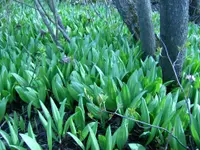
Ramp, Allium tricoccum, is a perennial woodland onion native to eastern North America. It grows in cool, moist, shaded forests, often in large colonies. The plant has broad, smooth green leaves that emerge in early spring, with a distinct garlicky-onion scent when crushed. Leaves die back before summer, and a slender stalk later carries small white flowers. In gardens, ramp can be slow to establish because it grows from bulbs and seeds and resents disturbance. It prefers shaded sites with rich, moist, well-drained soil, similar to a deciduous forest floor, and these conditions guide how to care for ramp.

Care Difficulty
Moderate Care

Light Preference
Partial Shade

Water Requirements
Regular Water

Temperature Preference
Cold Hardy

Hardiness Zone
3–7

Soil Texture
Loamy, Silty, Organic-rich

Soil pH
Acidic (5.5–6.5), Slightly acidic (6.5–7.0)

Soil Drainage
Moist but well-drained

Fertilization
Minimal (feed rarely)
Scan your plant to receive care tips personalized for your specific plant
Available on iOS and Android
This woodland species prefers cool, shaded conditions that mimic a deciduous forest floor.
This plant thrives in consistently moist, humus-rich soil that never stays waterlogged.
This species is adapted to cool, temperate woodland climates with cold winters and mild springs.
Humidity is not a major factor for Allium tricoccum, which adapts well to typical outdoor levels.
Allium tricoccum thrives in loose, moist, humus-rich forest-type soil with steady drainage.
This woodland species can be grown in containers if the pot mimics a cool, moist forest floor.
Allium tricoccum, or ramp, usually grows well in rich woodland soil and needs only light supplemental feeding in cultivation.
Pruning Allium tricoccum is minimal and mainly focuses on careful harvesting and sanitation.
Transplanting is more relevant than repotting for this woodland species, which prefers stable, long-term sites.
Propagation of Allium tricoccum is done mainly by bulb division and, more slowly, by seed.
This cold-hardy woodland onion requires little special winter care in most temperate climates.

Plant Health Check
Not sure what's wrong with your plant? Check your plant's health inside the app.
This species emerges and photosynthesizes in very early spring, completing most of its above‑ground growth before the forest canopy leafs out and then going dormant by early summer.
Wild ramp patches expand mainly through slow rhizome division and can take many years to recover from heavy harvesting, with some dense colonies estimated to be decades old.
Ramps are a traditional wild food for Indigenous communities and Appalachian cultures in eastern North America, where long-standing spring festivals and family foraging traditions center on this plant.

In parts of Quebec, overharvesting led to legal protection for ramps, and commercial sale from the wild has been restricted since the 1990s, making it one of the few wild edible forest herbs in North America with specific conservation regulations.
All parts are edible and strongly flavored, similar to a mix of garlic and onion. Leaves are usually harvested in early spring for cooking, pickling, or raw use. Bulb harvest should be limited to protect wild populations.
Keep your plants happy and healthy with plant identification, disease detection, and easy care guidance.