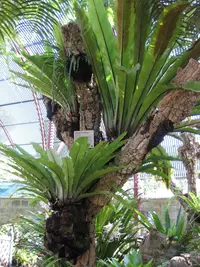
Bird's nest fern (Asplenium australasicum) Watering Guide

This page explains when, how often, and how much to water Asplenium australasicum in straightforward terms.

Water Requirements

Keep Soil Moist

Asplenium australasicum Watering

In its native tropical forest habitat, this fern grows where air stays humid and soil rarely dries completely. Asplenium australasicum prefers evenly moist potting mix, not soggy conditions or extended dryness.

Indoors, watering Bird's nest fern focuses on maintaining gentle, consistent moisture rather than strict schedules. Outdoor or greenhouse plants may need slightly more frequent checks, but the same moderate, steady approach applies.

Water Asplenium australasicum when the top 1–2 inches (3–5 cm) of potting mix feel evenly moist but not wet and are just starting to lose surface sheen, not when fully dry. This typically means watering about once a week indoors, slightly more often in warm, bright conditions and less in cooler, lower light.

Water Bird's nest fern when the top 1 inch (2–3 cm) of potting mix feels dry, keeping moisture consistently moderate.

  • Pour room-temperature water slowly onto the soil surface, circling the pot so the entire root zone becomes evenly moist.
  • Keep water away from the central rosette and frond bases, aiming between fronds so the crown remains dry.
  • Stop adding water when it begins to trickle from drainage holes, then empty saucers or decorative covers after several minutes.
  • For bottom watering, set the pot in a shallow tray of water, letting the mix wick moisture up before draining thoroughly.

Incorrect moisture levels quickly stress Asplenium australasicum and may trigger several avoidable physiological problems indoors.

Yellowing Fronds:

Older fronds turn uniformly pale and limp from chronic overwatering that suffocates roots and depletes oxygen.

Brown Frond Tips:

Dry, crisp tips appear when soil repeatedly dries too far or humidity stays very low.

Blackened Crown Base:

Central rosette darkens and softens due to stagnant, soggy soil encouraging fungal crown rot.

Mushy Root Mass:

Roots feel soft and brown when long-standing excess moisture prevents gas exchange and promotes decay.

Keep soil evenly moist, never waterlogged or bone-dry, letting only the surface slightly dry between waterings.

Unsuitable watering habits disturb the consistently moist yet airy conditions Asplenium australasicum needs, weakening growth and increasing stress sensitivity over time.

  • Watering by calendar: Following a fixed schedule ignores changing light and temperature; instead, water when the top inch of mix feels slightly dry to touch.
  • Dense, heavy potting mix: Using garden soil or peat-heavy mixes traps water; switch to a chunky, peat-free mix with bark or perlite for faster drainage.
  • Letting runoff sit in saucer: Leaving the pot standing in collected water keeps roots soggy; empty the saucer a few minutes after each watering.

Aim for evenly moist, never saturated soil in a well-draining mix, adjusting watering to room conditions and pot size throughout the year.

  • Spring: Increase watering as new fronds emerge, keeping the root zone evenly moist but letting the top surface just start to dry between waterings.
  • Summer: In heat or strong light, check moisture more often, preventing full drying while avoiding waterlogged soil that can cause crown rot.
  • Fall: Gradually reduce watering as growth slows, allowing slightly longer drying intervals while still protecting the fleshy roots from complete dryness.
  • Winter: With cooler temperatures and slower growth, water less often, keeping the mix lightly moist and avoiding cold, soggy conditions around the crown.

Your Bird's nest fern Care Companion

Use Botan for a simple watering guide and care routines tailored to Asplenium australasicum, plus gentle photo-based issue checks to spot early signs of stress or common problems.

Botan plant care app — identify plants on mobile

Interesting Watering Facts

Rainforest canopy runoff

In its native range on eastern Australian coasts and nearby islands, Asplenium australasicum often grows as an epiphyte on trees, receiving frequent light rains and heavy canopy runoff rather than deep soil moisture, which explains its preference for consistently moist but very well‑drained growing media in cultivation.


High humidity specialist

Wild populations are typically found in warm, humid lowland rainforests with high year‑round atmospheric moisture, a condition that helps the fronds resist desiccation; in homes, this translates to better performance with elevated humidity rather than simply increasing potting mix wetness.

FAQ

Check the top 1–2 inches (3–5 cm) of potting mix and water when it feels slightly dry, not fully dry. In average indoor conditions, this often means watering every 5–7 days, less often in winter.

Everything About Bird's nest fern

More Plant Watering Guides

Is Your Watering Routine Hurting Your Bird's nest fern?

Use Botan to review your watering pattern and adjust it with more confidence.

Watering a plant with a copper watering can
Plants That Repel Mosquitoes – 10 Effective Choices

8 min read · 6 Jul 2026

Plants That Repel Mosquitoes – 10 Effective Choices

Plants that repel mosquitoes can help mask human scent naturally and make outdoor spaces more comfortable. Explore the most effective options, their benefits and drawbacks, and choose the right plant for your space.

Plant Recommendations
Plants That Repel Mosquitoes – 10 Effective Choices
What Plants Don't Like Epsom Salt?

11 min read · 29 Jul 2026

What Plants Don't Like Epsom Salt?

Learn which plants can be seriously damaged by Epsom salt and which will thrive on it. We’ll explain when and how to use it properly, provide tips for indoor & outdoor plants — read on and enjoy a healthy garden.

Plant Care
What Plants Don't Like Epsom Salt?
How To Revive a Dying Plant: 6 Steps To Bring A Plant Back To Life

6 min read · 1 Sept 2026

How To Revive a Dying Plant: 6 Steps To Bring A Plant Back To Life

Drooping leaves and brown tips don't always mean the end, and a weakened plant can often recover with a little help. These six simple steps will help you revive a dying plant and restore its health.

Plant Care
How To Revive a Dying Plant: 6 Steps To Bring A Plant Back To Life