


melon Identification (Cucumis melo)

Recognize melon by its rough, trailing vine with coiled tendrils at the nodes and broad, heart- to kidney-shaped leaves borne alternately on long stalks.

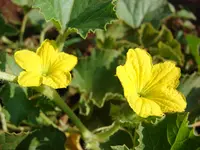
The flowers are yellow, five-lobed, and separate male and female blooms occur on the same plant; females sit behind a small swollen ovary that becomes the fruit.

Cucumis melo Identification

Check Your Plant ID

Take or upload a photo to confirm your plant ID with Botan.

Clear images work best. Avoid photos taken too close or too far away

  • 1 free identification
  • No sign-up
  • 30,000+ plants in database

Check the vine, leaves, flowers, and fruit shape on Cucumis melo.

  • Trailing or climbing vine with slender, rough stems and simple coiling tendrils at the nodes.
  • Leaves are alternate, broadly round to kidney-shaped, usually shallowly 3- to 5-lobed, about 4-8 inches (10-20 cm) wide.
  • Yellow flowers have five fused petals and grow singly in the leaf axils.
  • Fruits are round to oblong pepos, often with shallow ribs or a netted rind, and are much larger than the leaves.

Look for the combination of tendrilled vines, lobed leaves, yellow five-part flowers, and large ribbed or netted fruit.

Cucumis melo shows clear visual shifts from sprout to vine, flower, and fruit.

  • Seedling: Cotyledons appear first as smooth, oval seed leaves. The first true leaves are rougher, shallowly lobed, and begin the plant’s trailing habit.
  • Young plant: Stems lengthen into creeping or climbing vines with tendrils at the nodes. Leaves become broader, heart-shaped to weakly lobed, often 3-6 inches (8-15 cm) across.
  • Flowering stage: Small yellow five-petaled flowers appear singly in leaf axils on the vine. Male flowers are more numerous, while female flowers show a swollen base behind the petals.
  • Fruiting stage: After pollination, the swollen flower base enlarges into a round to elongated pepo, a hard-rinded berry, while vines remain sprawling and flowers may still be present.

Melon has several market types that are easy to separate by fruit rind pattern, shape, and flesh color.

  • cantaloupe group: Usually round, with a tan rind covered by strong corky netting and orange flesh; fruits are often about 5 to 7 inches (13 to 18 cm) across.
  • honeydew group: Typically smoother-skinned than cantaloupes, with little to no netting, a pale green to creamy rind, and green or white flesh.
  • casaba group: Often larger and more elongated, with a yellow rind that is wrinkled or furrowed rather than heavily netted.
  • Canary melon group: Distinct for its bright yellow, smooth rind and elongated oval shape, usually with pale flesh.

In warm growing weather, Cucumis melo quickly develops long trailing vines with rough, lobed leaves. By summer, yellow flowers become easy to spot along the stems, adding a clear seasonal clue. Later in summer into fall, the plant is most recognizable when the developing melons swell beneath the foliage. After the season ends, frost or age causes the vines and leaves to collapse and dry, leaving no woody structure.

A few cucurbits are regularly mistaken for melon at a glance.

cucumber(Cucumis sativus)

Similar as a trailing vine with rough, lobed leaves and yellow flowers. Check the fruit: cucumber is usually long and cylindrical; melon develops rounder to oval fruit with thicker stems and often a netted or smoother rind.

West Indian gherkin(Cucumis anguria)

Similar young vines can resemble it in leaf shape and habit. The quickest difference is the fruit: West Indian gherkin bears small oval fruits covered in soft spines, not the larger smooth or netted fruits seen on melon.

Scan. Check. Confirm.

Use Botan to identify or verify a plant from a photo, helping avoid mix-ups with similar species.

FAQ

This annual vine has rough, lobed green leaves, yellow five-petaled flowers, curling tendrils, and fleshy fruit that varies widely in size, shape, rind texture, and color. Those combined traits are central to melon plant identification.

Everything About melon

More Plant Identification Guides

Identify It. Learn More About It.

Use Botan to identify a plant from a photo, then view plant details, care information, and common problems for that species.

Botan app identifying a plant from a photo
12 Most Wanted Rare Houseplants to Grow at Home

6 min read · 21 Sept 2026

12 Most Wanted Rare Houseplants to Grow at Home

Rare houseplants can turn an ordinary corner in your apartment into a living botanical collection. This guide covers 12 most admired picks, what makes them special, and how to grow them successfully at home.

Plant Recommendations

12 Most Wanted Rare Houseplants to Grow at Home
13 Best Front Yard Trees for Every Home and Yard

12 min read · 7 Aug 2026

13 Best Front Yard Trees for Every Home and Yard

A front yard tree can stay for decades. Therefore, choosing one deserves serious consideration. Here are 13 trees that have proven themselves, sorted by their purpose. You'll also find five species to avoid and basic planting information.

Plant Recommendations
13 Best Front Yard Trees for Every Home and Yard
How to Water Houseplants: Watering Guide

7 min read · 24 Aug 2026

How to Water Houseplants: Watering Guide

Learn how often to water indoor plants, key factors for proper watering, and how to adjust the care routine by plant type, season, pot size, light, and indoor conditions.

Plant Care
How to Water Houseplants: Watering Guide