Rotate For Symmetry
Turn the pot 90° every 2–3 weeks so rosettes receive even light and develop a balanced, upright form instead of leaning toward the brightest side.

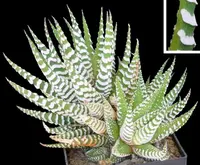
Haworthiopsis attenuata, commonly called zebra haworthia, is a small succulent from South Africa. It forms tight rosettes of firm, pointed leaves marked with white horizontal ridges. The plant stays compact and slow-growing, which makes it suitable for desks, windowsills, and small indoor spaces. It rarely needs repotting and generally keeps a tidy shape without pruning. This species stores water in its leaves, so it tolerates short dry periods and irregular watering better than many houseplants. With bright indirect light, gritty, fast-draining soil, and moderate watering, it remains healthy and attractive. These traits make it straightforward for beginners who want to learn how to care for Zebra Haworthia.

Care Difficulty
Easy Care

Light Preference
Bright Indirect Light

Water Requirements
Low Water

Temperature Preference
Tropical / Frost Sensitive

Hardiness Zone
10–11

Soil Texture
Sandy, Loamy, Rocky

Soil pH
Acidic (5.5–6.5), Slightly acidic (6.5–7.0)

Soil Drainage
Well-drained

Fertilization
Minimal (feed rarely)
Scan your plant to receive care tips personalized for your specific plant
Available on iOS and Android
Haworthiopsis attenuata prefers bright, indirect light with brief gentle direct sun each day.
Watering for Haworthiopsis attenuata should mimic a dry, episodic desert rainfall pattern.
This succulent favors warm, stable conditions with protection from frost and extreme heat swings.
This species is adapted to dry conditions and usually does well in typical indoor humidity.
Haworthiopsis attenuata prefers a very fast-draining, mineral-rich substrate that dries quickly between waterings.
This compact succulent is very suitable for container growing.
Haworthiopsis attenuata needs only light, infrequent feeding to stay healthy in typical indoor conditions.
Pruning needs for Haworthiopsis attenuata are minimal and focus on hygiene rather than reshaping the plant.
This succulent prefers snug pots and only occasional repotting when clearly rootbound or declining.
This species is most commonly multiplied by offsets, with leaf cuttings and seeds used less often.
This succulent is not frost hardy and needs simple indoor winter management in most temperate climates.

Plant Health Check
Not sure what's wrong with your plant? Check your plant's health inside the app.
This species occurs in two main forms, a narrow-leaved type (often called var. attenuata) and a thicker, more robust, banded type (often called var. fasciata), both sharing the characteristic raised white tubercles on the outer leaf surfaces.
It uses crassulacean acid metabolism (CAM), opening stomata mainly at night to take in CO₂, which helps it conserve water and tolerate the highly seasonal, dry conditions of its native Eastern Cape habitats in South Africa.
In nature it often expands by producing numerous basal offsets that remain attached, forming tight clumps which help stabilize the shallow, sandy soils it typically inhabits.

Genetic and morphological studies have shown that this species, long placed in the genus Haworthia, is distinct enough to be classified in the separate genus Haworthiopsis, reflecting its different evolutionary lineage within the Asphodelaceae family.
This species is slow-growing, usually adding only a few leaves and a small amount of height each year. In typical indoor conditions, it may take 3–5 years to reach a mature rosette size.
Keep your plants happy and healthy with plant identification, disease detection, and easy care guidance.