Salt-spray tolerance
In coastal areas, place plants slightly inland or behind a windbreak so foliage is protected from the strongest salt-laden winds, which reduces leaf burn and dieback when growing Japanese holly.

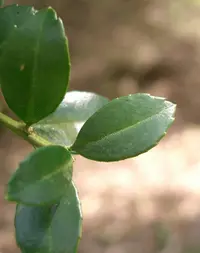
Japanese holly, Ilex crenata, is an evergreen shrub commonly used for hedges, foundation plantings, and formal garden shapes. It has small, glossy, boxwood-like leaves and dense, fine branching.
In the wild, it is native to Japan, Korea, and parts of China, where it grows in woodland and hillside habitats. Many compact cultivars stay relatively low and respond well to pruning.
The plant is valued for its year-round structure, small black berries on female plants, and generally steady growth. Understanding how to care for Japanese holly is important because it prefers consistent moisture, slightly acidic, well-drained soil, and at least bright outdoor light.

Care Difficulty
Moderate Care

Light Preference
Partial Sun

Water Requirements
Moderate Water

Temperature Preference
Cold Hardy

Hardiness Zone
5–8

Soil Texture
Sandy, Loamy, Organic-rich

Soil pH
Strongly acidic (4.5–5.5), Acidic (5.5–6.5)

Soil Drainage
Moist but well-drained

Fertilization
Light (every 4–6 weeks)
Scan your plant to receive care tips personalized for your specific plant
Available on iOS and Android
This shrub prefers consistent light conditions to maintain dense, healthy foliage.
Watering should support steady growth while preventing root rot.
This species is cold-hardy but still benefits from stable temperature conditions.
This species manages well in typical outdoor humidity but benefits from consistent mid-range moisture in the air.
Ilex crenata prefers evenly moist, well-aerated soil with a fine to medium texture.
This shrub is well suited to container growing when moisture and stability are carefully managed.
Japanese holly benefits from modest, consistent nutrition rather than heavy feeding.
Pruning Ilex crenata helps maintain dense structure and healthy foliage.
Ilex crenata in containers or landscape beds benefits from thoughtful transplanting to reduce stress.
Propagation of Ilex crenata is most reliable from semi-hardwood cuttings.
Ilex crenata is generally cold hardy but benefits from simple winter care, especially in containers.

Plant Health Check
Not sure what's wrong with your plant? Check your plant's health inside the app.
Unlike many hollies, this species has small, smooth-edged leaves with no spines, which is why it is often confused with boxwood in hedges and topiary planting.
It forms a dense, fibrous, shallow root system adapted to forest-edge soils, which makes it tolerant of pruning and transplanting but sensitive to deep soil disturbance and poor drainage.
The plant produces many dormant buds along its stems, so it responds to frequent shearing with dense, fine branching, a trait that makes it a standard choice for formal hedges and bonsai in Ilex crenata care.

Wild populations of this species are native to Japan, Korea, parts of China, and Sakhalin, where it grows in cool, humid, often mountainous habitats, which is why many cultivated forms show good cold tolerance compared with other broadleaf evergreens.
Yellowing leaves usually result from poor drainage, compacted or alkaline soil, root rot, or nutrient deficiency, especially iron. Check drainage, avoid overwatering, test soil pH, and apply an appropriate fertilizer or chelated iron if needed.
Keep your plants happy and healthy with plant identification, disease detection, and easy care guidance.