Support And Training
Install a sturdy trellis or horizontal wires early, then tie new shoots loosely with soft ties so the plant develops a stable framework that can carry heavy flowering growth without breaking.

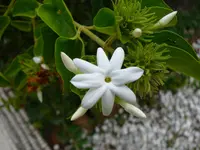
Star jasmine, Jasminum multiflorum, is a woody, evergreen climber or sprawling shrub grown for its clusters of small, white, star-shaped flowers and dense green foliage. It is native to parts of India and Southeast Asia, where it naturally scrambles over other vegetation in warm, frost-free climates.
In gardens it can be trained on trellises, fences, or grown as a loose, flowering shrub. It is generally considered a moderate-care plant, as it grows quickly and flowers well if light, warmth, and moisture are reasonably consistent.
Those who want to learn how to care for star jasmine should know it prefers bright light, well-drained soil, and regular but not excessive watering, especially during active growth.

Care Difficulty
Moderate Care

Light Preference
Full Sun

Water Requirements
Moderate Water

Temperature Preference
Tropical / Frost Sensitive

Hardiness Zone
9–11

Soil Texture
Sandy, Loamy, Organic-rich

Soil pH
Acidic (5.5–6.5), Slightly acidic (6.5–7.0)

Soil Drainage
Moist but well-drained

Fertilization
Light (every 4–6 weeks)
Scan your plant to receive care tips personalized for your specific plant
Available on iOS and Android
This jasmine prefers bright outdoor light tailored to avoid harsh extremes.
This plant prefers steady moisture without staying waterlogged.
This jasmine favors warm, frost-free conditions for reliable growth and flowering.
This species prefers moderate humidity and benefits from slightly moister air than is typical in heated homes.
This shrub performs best in loose, well-drained, moderately fertile soil that holds some moisture without staying wet.
This species is well suited to container growing, especially where outdoor winters are too cold.
Jasminum multiflorum responds well to moderate feeding that supports steady vegetative growth and flowering.
Jasminum multiflorum benefits from thoughtful pruning to maintain shape and flowering performance.
Container‑grown Jasminum multiflorum appreciates timely repotting or transplanting to sustain healthy root growth.
Jasminum multiflorum is commonly propagated vegetatively to match the parent plant’s traits.
Jasminum multiflorum is frost sensitive and needs protection in regions with cold winters.

Plant Health Check
Not sure what's wrong with your plant? Check your plant's health inside the app.
In warm climates, this species can flower almost continuously through the year, rather than in a single short season, because it forms new flower buds on current-season growth.
The star-shaped white flowers are fragrant but usually produce little to no nectar, so they are visited mainly by scent-oriented pollinators that respond to the strong night and early-morning perfume.
Individual buds often open in the evening or at night and stay at peak whiteness for a short time, which helps the plant attract nocturnal pollinators that use visual contrast and scent to find flowers.
Lack of flowers often comes from insufficient light, heavy nitrogen fertiliser, or pruning at the wrong time, which removes flower buds. Stress from recent repotting, root disturbance, or cold snaps can also delay or reduce blooming.
Keep your plants happy and healthy with plant identification, disease detection, and easy care guidance.