Inoculate Before Sowing
Coat seeds with the correct Rhizobium inoculant just before sowing to improve nitrogen fixation and stand vigor, especially in fields that have not grown Lucerne for several years.

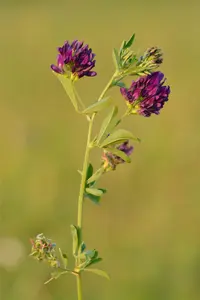
Lucerne, also known as alfalfa, is a long-lived herbaceous legume grown mainly as a forage crop. Medicago sativa forms deep roots and dense, leafy shoots. Plants usually appear as clumping mounds with fine stems and small trifoliate leaves, often topped with clusters of purple flowers. It is native to southwestern Asia but is now widely cultivated in temperate regions worldwide. Lucerne fixes nitrogen in the soil, which improves fertility and supports vigorous growth where conditions suit it. It grows best in open, sunny sites with well-drained, moderately fertile soil and regular, even moisture. These traits make it relatively straightforward for farmers and gardeners who want to care for Lucerne in suitable climates.

Care Difficulty
Moderate Care

Light Preference
Full Sun

Water Requirements
Moderate Water

Temperature Preference
Cold Hardy

Hardiness Zone
3–9

Soil Texture
Sandy, Loamy, Clay

Soil pH
Slightly alkaline (7.0–7.5), Alkaline (7.5–8.5)

Soil Drainage
Well-drained

Fertilization
Minimal (feed rarely)
Scan your plant to receive care tips personalized for your specific plant
Available on iOS and Android
Medicago sativa needs strong, direct light to maintain vigorous growth and high biomass production.
Medicago sativa prefers evenly moist, well-drained soil and is sensitive to both waterlogging and extended drought during establishment.
This species is a cool- to warm-season perennial that tolerates a wide range of field temperatures once established.
This species tolerates a wide humidity range and usually does not need special humidity management outdoors.
Medicago sativa prefers deep, well-drained, moderately fertile soil for healthy root and shoot growth.
This species can be grown in containers, mainly for small-scale trials or fodder use rather than long-term stands.
Medicago sativa fixes its own nitrogen but benefits from modest feeding on poorer soils.
Pruning Medicago sativa is mainly tied to harvest and stand management rather than shaping.
Lucerne is usually field-grown, so focus on careful transplanting rather than frequent repotting.
Medicago sativa is most commonly propagated from seed for uniform, dense stands.
Established Medicago sativa is cold hardy in many temperate regions and needs limited winter care.

Plant Health Check
Not sure what's wrong with your plant? Check your plant's health inside the app.
Alfalfa forms roots that can extend several meters into the soil, allowing it to access deep water reserves and tolerate drought better than many other forage crops.
This species forms nodules on its roots that host Rhizobium bacteria, which convert atmospheric nitrogen into forms the plant can use, reducing the need for synthetic nitrogen fertilizers in crop rotations.
Among common forage plants, alfalfa is notable for its relatively high protein content and digestibility, which is why it is widely grown Medicago sativa plant care and nutrition research often focuses on optimizing this quality for livestock feed.

Medicago sativa is one of the oldest known cultivated forage crops, with archaeological evidence suggesting it was grown and fed to horses in ancient Persia more than 2,000 years ago before spreading through Greece and the wider Mediterranean region as a valued fodder plant.
Young leaves and sprouts are edible when grown cleanly and consumed in moderate amounts, often used in salads or as herbal tea. Raw seeds and large quantities of sprouts may cause digestive upset or interact with certain medications.
Keep your plants happy and healthy with plant identification, disease detection, and easy care guidance.