

Lemon balm Identification (Melissa officinalis)

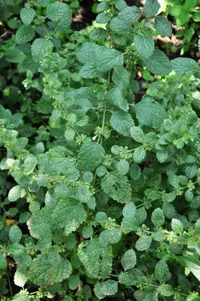
Recognize Melissa officinalis by its opposite pairs of oval, softly wrinkled leaves with rounded teeth, carried on square stems. Plants form a low, branching clump, usually about 1 to 3 feet (30 to 90 cm) tall.

Small white to pale yellow flowers sit in clusters at the leaf nodes rather than in a terminal spike.

Melissa officinalis Identification

Check Your Plant ID

Upload a clear photo to check your plant identification with Botan.

Clear images work best. Avoid photos taken too close or too far away

Check Melissa officinalis for a soft, leafy mound with opposite leaves and square stems.

  • Leaves are broadly oval to heart-shaped, with rounded teeth and a puckered surface.
  • Leaf pairs sit directly opposite each other along upright, branching stems.
  • Leaves are usually 2-3 inches (5-8 cm) long, on slender stalks.
  • Small white to pale yellow flowers appear in little clusters where leaves meet the stem.

Crush a leaf only if needed; the plant should show a clear lemon scent.

Melissa officinalis shows useful visual changes from early leafy growth to flowering stems.

  • Seedling: Seedlings show opposite first leaves on short stems; blades are small, rounded to ovate, with shallow scalloping and a softer, less wrinkled surface.
  • Young plant: Young plants form a low, leafy clump. Leaves become broader and more heart-based, with clearer serrated edges and stronger veining than seedlings.
  • Mature plant: Mature plants develop many upright, square stems from the base, making a bushy mound about 1-3 feet (30-90 cm) tall and noticeably wider than young plants.
  • Flowering stage: At flowering, upper stems elongate and branch. Small white to pale yellow flowers appear in clustered leaf axils, changing the outline from leafy mound to tiered stems.

Several named forms of Lemon balm are identifiable by leaf color and growth habit.

  • 'Aurea': New growth is bright golden yellow rather than medium green, especially in spring; older leaves often age to yellow-green.
  • 'All Gold': Foliage stays a clearer chartreuse to golden yellow across much of the plant, not just at the shoot tips.
  • 'Variegata': Leaves show irregular creamy white to pale yellow marbling or edge variegation instead of solid green.
  • 'Lime': Leaves are distinctly lighter, lime-green, giving the whole plant a paler look than the typical form.

In spring, Melissa officinalis sends up fresh, soft green leaves in dense clumps, making the crinkled, opposite leaf pairs especially easy to spot. By early to mid summer, small white to pale yellow flowers appear in the leaf axils, then the top growth often dies back after frost, leaving a low, dormant crown through winter.

A few mint-family herbs are regularly mistaken for Lemon balm.

catnip(Nepeta cataria)

Both have opposite, softly toothed leaves on square stems. Catnip is grayer and fuzzier, with more triangular leaves and deeper teeth; Melissa officinalis is brighter green with rounder, crinkled leaves.

spearmint(Mentha spicata)

Both form leafy, aromatic clumps with serrated leaves. Spearmint usually has narrower, smoother leaves and dense terminal flower spikes; Melissa officinalis has broader, heart-based leaves and small white flowers in the leaf axils.

white horehound(Marrubium vulgare)

It can resemble a wrinkled mint at first glance. White horehound is gray-green and densely woolly, with rounder scalloped leaves; Melissa officinalis is greener and less hairy.

Melissa officinalis is native to southern Europe, the Mediterranean region, and parts of western Asia. In the wild it is found around woodland edges, scrub, hedgebanks, and other disturbed places rather than deep forest or wetland. That habitat helps with identification because true wild plants are most likely in temperate Eurasian settings, often in semi-shaded, human-influenced ground. A supposed wild match from marshes, deserts, or tropical forest would be less consistent with Melissa officinalis.

Confirm It from a Photo

Use Botan to identify or verify the plant from an image, which helps avoid mix-ups before buying, labeling, or planting.

FAQ

Catnip usually has grayer, more softly fuzzy leaves and a stronger minty odor. This plant has brighter green, softly wrinkled leaves with a distinct lemon scent when crushed, which is central to Lemon balm identification.

More Plant Identification Guides

Identify the Plant and Get Its Profile

Upload a photo to identify the plant, then review care information, safety notes, and common problems matched to that species.

Botan app identifying a plant from a photo
Plants That Repel Mosquitoes – 10 Effective Choices

8 min read · 6 Jul 2026

Plants That Repel Mosquitoes – 10 Effective Choices

Plants that repel mosquitoes can help mask human scent naturally and make outdoor spaces more comfortable. Explore the most effective options, their benefits and drawbacks, and choose the right plant for your space.

Plant Recommendations
Plants That Repel Mosquitoes – 10 Effective Choices
Planting Grass Seed in Summer – What Works and What Fails

7 min read · 6 Aug 2026

Planting Grass Seed in Summer – What Works and What Fails

Summer seeding succeeds when the grass type suits the season, and the soil stays moist. Find out how to prepare the seedbed and choose a safe window for planting.

Plant Care
Planting Grass Seed in Summer – What Works and What Fails
12 Best Landscaping Trees for Your Garden

8 min read · 6 Oct 2026

12 Best Landscaping Trees for Your Garden

Choosing the landscape tree depends on what your garden needs most. These 12 options include compact flowering specimens, colorful deciduous trees, shade varieties, and evergreens suitable for screening and year-round structure.

Plant Recommendations
12 Best Landscaping Trees for Your Garden