Host root planning
Before planting, plan nearby host plants (such as native grasses or shrubs) within 30–150 cm of the root zone so the hemiparasitic roots can attach and improve long-term vigor.

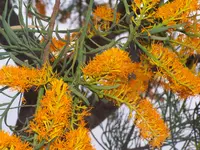
Nuytsia floribunda, often called the Western Australian Christmas tree, is a long‑lived, semi-parasitic tree native to nutrient-poor sandy soils of southwestern Australia. It taps the roots of nearby plants for water and minerals while still performing its own photosynthesis.
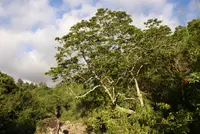
The tree forms an open, spreading crown with narrow leaves and spectacular masses of bright yellow to orange flowers in the Australian summer holiday period. It is adapted to hot, dry climates and does best in full sun and very well-drained soils.
Because of its specialized root relationships and climate needs, it is challenging to establish outside its natural range. Gardeners interested in how to care for Christmas Tree should understand that it is not a typical ornamental tree for beginners.

Care Difficulty
Hard Care

Light Preference
Full Sun

Water Requirements
Low Water

Temperature Preference
Tropical / Frost Sensitive

Hardiness Zone
10–11

Soil Texture
Sandy, Loamy, Rocky

Soil pH
Slightly acidic (6.5–7.0), Neutral (7.0)

Soil Drainage
Well-drained

Fertilization
Minimal (feed rarely)
Scan your plant to receive care tips personalized for your specific plant
Available on iOS and Android
This hemiparasitic Western Australian tree needs abundant sun to flower and grow well outdoors.
This species is drought-adapted and prefers infrequent, deep watering once established in freely draining soil.
This tree thrives in warm Mediterranean-type climates with mild, dry summers and cool, frost-free winters.
Nuytsia floribunda is adapted to dry Mediterranean climates and does not need elevated humidity.
Nuytsia floribunda needs very free-draining, sandy soil that mimics its native, low-fertility habitats.
This species is generally unsuitable for long-term container growing due to its size, root behavior, and specialized ecology.
This semi-parasitic Western Australian tree is highly adapted to nutrient-poor soils and usually needs no fertilizer once established.
Nuytsia floribunda benefits from minimal, well-timed pruning aimed at safety and structure rather than heavy shaping.
This species resents root disturbance, so any repotting or transplanting must be infrequent, careful, and planned early in the plant’s life.
Propagation of Nuytsia floribunda is specialized and difficult, mainly due to its semi-parasitic root system that requires suitable host plants.
Mature plants are adapted to mild, dry winters and usually need little special winter care in frost-free or very light-frost climates.

Plant Health Check
Not sure what's wrong with your plant? Check your plant's health inside the app.
This species is a root hemiparasite that forms specialized organs called haustoria, which tap into nearby plants’ roots to draw water and nutrients while still performing its own photosynthesis.
In southwestern Australia it erupts into bright orange to yellow blossom displays around late spring to summer, often making entire trees appear flame-colored in otherwise dry landscapes.
It naturally grows in nutrient-poor sandy or lateritic soils, and its parasitic habit is thought to be an adaptation that allows it to access additional resources in this harsh environment.

This tree is sometimes called the world’s largest mistletoe because, unlike most mistletoes that live as small shrubs on branches, it forms a full-sized, free-standing tree while still parasitizing the roots of many surrounding plants, including grasses and crops.
This species needs full sun, maturity, and seasonal dryness to set flowers. Lack of strong light, too much irrigation, or a very young plant often delays blooming, even if overall Nuytsia floribunda care seems correct.
Keep your plants happy and healthy with plant identification, disease detection, and easy care guidance.