

Nail Fungus Identification (Poronia punctata)

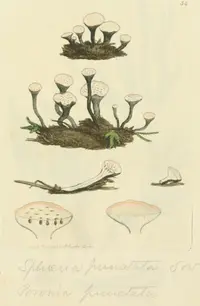
Recognize Poronia punctata by its small, flat, disk-like fruiting bodies on a short stalk, usually under 1 inch (2.5 cm) wide.

Each white to pale gray disk is dotted with many tiny black pore-like openings, giving the surface a distinctly speckled, nail-head look.

Poronia punctata Identification

Check Your Plant ID

Use a clear photo to confirm what plant you have.

Clear images work best. Avoid photos taken too close or too far away

Poronia punctata is checked by its small, flat, disc-like fruiting bodies on a short stalk.

  • Each disc is round to slightly irregular and usually white to pale gray.
  • The upper surface shows many tiny black dots, giving a peppered look.
  • Fruiting bodies are typically about 0.4-1.2 inches (1-3 cm) across.
  • They grow low and close to the substrate, not as tall mushrooms with caps and gills.

Look for the flat white disc with black pinpoints first, since that combination is the fastest visual check.

Poronia punctata shows clear visual changes as its fruiting bodies expand and age.

  • Young plant: Early fruiting bodies appear as small, pale, rounded pads on dung, with the dark embedded dots not yet prominent.
  • Mature plant: At maturity, each disc becomes broader and flatter, often about 0.4-1 inch (1-2.5 cm) across, with a distinct black-speckled upper surface.
  • Fruiting stage: The fertile stage is marked by conspicuous black perithecial openings, flask-shaped spore chambers, scattered across the white to gray disc and visible without magnification.

Poronia punctata is most noticeable when its fruiting bodies appear in warm months on old dung. These small, flat-topped, white to pale gray discs with black pore dots are the main seasonal clue. As they age, the discs often become dingier, crack, or wear away, making older specimens less distinct. Outside the fruiting period, there is usually little visible above the substrate to identify.

Poronia punctata is known from Europe and has also been recorded in parts of North America. It is most often found on old dung in short-grazed grassland, especially pasture used by horses or cattle. That habitat is a strong identification clue. Finding it on weathered dung in open grassland helps separate it from many small black fungi that grow on wood, soil, or leaf litter instead.

Poronia punctata is a dung-inhabiting mushroom, so the main safety concern is misidentification and handling rather than known toxicity from the fungus itself.

  • Wrong mushroom risk: Any wild mushroom can be confused with another species. For humans, ingestion is the main hazard if identification is wrong.
  • Contaminated substrate: It grows on animal dung. For humans and pets, contact with the fruiting bodies or nearby substrate can expose skin to manure residues and microbes; ingestion is the clearer risk.

Confirm It from a Photo

Use Botan to identify or double-check a specimen from an image, which helps reduce mix-ups before you label or record it.

FAQ

Look for small white, nail-like fruiting bodies with a flat to slightly convex disc dotted by tiny black pores. It usually grows on old horse dung, a key clue when identifying Nail Fungus.

Everything About Nail Fungus

More Plant Identification Guides

Identify Your Plant and Learn More

Use Botan to identify a plant from a photo, then view species-specific care information, safety notes, and common problems.

Botan app identifying a plant from a photo
Best Fertilizer for Vegetable Gardens – What to Use for Each Plant

11 min read · 20 Jul 2026

Best Fertilizer for Vegetable Gardens – What to Use for Each Plant

Here, you’ll find the right fertilizer formula for vegetables in your garden. Learn how to adjust feeding correctly throughout the growing cycle, spot nutrient deficiencies by their symptoms, and keep your plants healthy and prolific.

Plant Recommendations

Best Fertilizer for Vegetable Gardens – What to Use for Each Plant
12 Best Cold-Hardy Vegetables for Cold Weather

7 min read · 13 Oct 2026

12 Best Cold-Hardy Vegetables for Cold Weather

Cold-hardy vegetables can keep a garden productive through chilly fall, winter, and early spring weather. This guide covers 12 reliable crops, their frost tolerance, and practical growing tips for better cold-season harvests.

Plant Recommendations
12 Best Cold-Hardy Vegetables for Cold Weather
Plants That Repel Bugs – 20 Effective Options

12 min read · 16 Jul 2026

Plants That Repel Bugs – 20 Effective Options

Mosquitoes on the patio? Gnats in the kitchen? Some plants keep them away with the scent of their own leaves. Here are 20 that deal with mosquitoes, flies, aphids, and more, plus where to put them so they help.

Plant Recommendations
Plants That Repel Bugs – 20 Effective Options