

teak Identification (Tectona grandis)

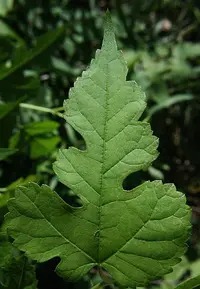
Recognize teak by its very large opposite leaves, usually oval to broadly elliptic, often 12 to 24 inches (30 to 60 cm) long, on stout square young stems.

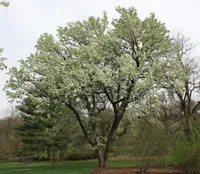
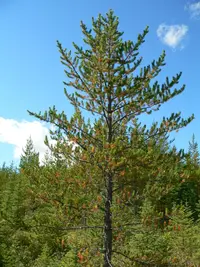
Mature trees also show a straight trunk and broad terminal clusters of many small white flowers held above the foliage.

Tectona grandis Identification

Is This teak?

Take or upload a photo to confirm your plant ID with Botan.

Clear images work best. Avoid photos taken too close or too far away

Check the leaves, branching, and flower clusters on Tectona grandis.

  • Leaves are opposite, very large, simple, and broadly oval, often 12-24 inches (30-60 cm) long with a pointed tip.
  • Leaf surfaces look rough above and softly hairy beneath; the veins stand out clearly.
  • Branching is open and tiered, with stout twigs carrying paired leaves at each node.
  • Flowers appear in large, airy clusters at branch tips; each small flower is pale and tubular with 5-6 lobes.

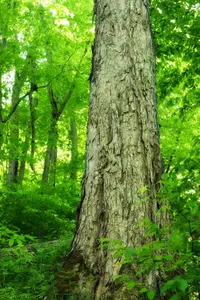
A mature tree also shows a straight trunk with gray-brown bark that becomes fissured.

Tectona grandis shows clear visual shifts from broad-leaved sapling to tall flowering tree.

  • Seedling: Seedlings carry a few opposite leaves on a soft green stem; the first true leaves are simple, broad, and noticeably rougher above.
  • Young plant: Young plants show very large opposite leaves, often 12-24 inches (30-60 cm) long, with little branching and a stout, upright stem.
  • Mature plant: Mature trees develop a straight trunk with gray to brown bark and a broader crown; lower leaves are smaller than on younger plants.
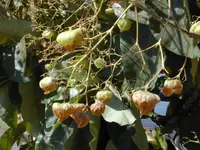
  • Fruiting stage: After flowering, branch tips hold many small, rounded fruits enclosed by enlarged papery calyx lobes, creating pale, airy clusters distinct from leafy shoots.

In the dry season, Tectona grandis often becomes briefly deciduous, shedding its very large leaves and leaving stout, widely spaced branches exposed. In summer, large branched clusters of small pale flowers become conspicuous at branch tips. Later, rounded fruits develop and may persist after leaf drop, adding another seasonal clue.

A few large tropical trees can be mistaken for teak at a glance.

African teak(Milicia excelsa)

Both are tall timber trees with broad simple leaves. African teak usually has smaller, firmer leaves with a rougher surface, while Tectona grandis has much larger, soft, felted leaves and more obvious opposite leaf pairs.

beechwood or gamhar(Gmelina arborea)

This species also has opposite, broad leaves and a straight trunk, so young trees are sometimes confused. Gamhar leaves are commonly more heart-shaped and less velvety, and its yellow flowers are showier than teak’s small pale flower clusters.

Tectona grandis is native to South and Southeast Asia, especially India, Myanmar, Laos, and Thailand. In the wild it occurs in tropical deciduous forests, often in areas with a marked dry season. That setting helps with identification because teak is more likely in seasonally dry inland forest than in rainforest, mangroves, or swampy ground. Wild populations are commonly found from lowlands into foothills, roughly to about 3,300 feet (1,000 m).

Scan. Check. Confirm.

Use Botan to identify or confirm a plant from a photo, which helps avoid mix-ups before you label it or compare sources.

FAQ

The standout trait is its very large, opposite leaves, often rough above and softly hairy beneath. Mature leaves can reach about 12 to 24 inches (30 to 60 cm) long, which helps with identifying teak.

Everything About teak

More Plant Identification Guides

From Plant ID to Plant Info

Identify a plant from a photo with Botan, then get species-specific care information, safety notes, and common problems.

Botan app identifying a plant from a photo
Best Fertilizer for Grass in Summer: How to Choose the Right One

6 min read · 18 Aug 2026

Best Fertilizer for Grass in Summer: How to Choose the Right One

The right fertilizer in summer can make a lawn thrive. The wrong one can damage it. Here, you’ll learn the best NPK ratios by grass type, when and how to apply your formula, and how to recognize the signs of over- or under-fertilizing.

Plant Care
Best Fertilizer for Grass in Summer: How to Choose the Right One
How to Tell if a Plant Is Dead

6 min read · 19 Aug 2026

How to Tell if a Plant Is Dead

A plant can lose its leaves, stop growing, or collapse and still remain alive. A closer look at the stems, roots, bulbs, and tubers can show whether the plant still has a chance to recover.

Beginner Guides
How to Tell if a Plant Is Dead
Plant Pot Sizes: How to Choose the Right Plant Container

7 min read · 20 Aug 2026

Plant Pot Sizes: How to Choose the Right Plant Container

Plant pot sizes can be confusing because the number on the label only tells you part of the required information. A container may look spacious but actually be too shallow. So, how to choose pot size for plant species?

Beginner Guides
Plant Pot Sizes: How to Choose the Right Plant Container