Powdery Mildew on Roses: How to Stop the White Dust Before It Ruins Your Blooms
Powdery mildew on roses can appear quickly when conditions like poor airflow, temperature swings, or overfertilization favor fungal growth. It is manageable if you treat it early. Let's know how to do it.

On this page
- Why Roses Get Powdery Mildew
- Poor Air Circulation
- Warm Days, Cool Nights, and High Humidity
- Too Much Shade
- Soft New Growth From Overfertilizing
- Catching Rose Problems Earlier With Smart Plant Care
- Powdery Mildew vs. Other Possible Problems
- Step-by-Step Guide on How to Treat the Plant
- Step 1: Remove the Worst-Affected Parts
- Step 2: Use a Suitable Fungicide or Home Treatment
- Step 3: Repeat and Monitor
- Natural Ways to Keep the Problem Away
Why Roses Get Powdery Mildew
Podosphaera pannosa is the fungus that causes white mildew on roses. It survives the winter attached to plant parts and starts producing spores in spring. Under favorable conditions, it can spread the new generation of spores every 3 days.
Like other pathogens, it appreciates some level of moisture but doesn’t require standing water. But it thrives in environments with poor air circulation, low light, temperature fluctuation, and overfertilized soil.

Poor Air Circulation
Rose bush powdery mildew develops when plants are packed too close together or located close to thick fences, walls, and even large trees. In such “pockets”, air isn’t circulating properly and stagnates. Moisture doesn’t evaporate quickly enough, and humidity can reach 70-90%.
This creates a perfect environment for fungi. Spores germinate quickly and easily, causing mildew. Note that it can happen even when the humidity throughout the garden is normal. Check the specific spots where roses grow.
Warm Days, Cool Nights, and High Humidity
High humidity promotes mildew spore formation, while a drop in humidity triggers their release. The spores then spread by wind to new hosts, where, unlike most fungi, they can germinate without any free moisture on the leaf surface. Cool nights and warm days create ideal conditions for the disease to take hold.
The ideal temperature for the fungus is 68°-77°F (20-25°C), and the humidity level must reach around 70%. The soil, or even the leaves, don't have to be wet — only the air must be humid. Also, most spores can't stand temperatures above 95°F (35°C), so the disease doesn't spread that actively during the summer heat in most regions.
Too Much Shade
There are two reasons why too much shade can lead to powdery mildew. First, without enough sunlight, moisture doesn’t evaporate quickly enough. That’s how a high-humidity environment with poor airflow is created.
Second, excessive shade weakens the plant overall, so its immune response to fungal disease will be weaker.
Soft New Growth From Overfertilizing
Overfeeding your rose with nitrogen can have unexpected consequences. For example, beach rose with this procedure will grow much faster, but it will also produce many new leaves and buds with thin, sappy cell walls. These parts of the rose can’t resist the fungus as well as mature, toughened leaves and flowers can.
Note that using nitrogen fertilizers is especially dangerous in late summer, when nighttime temperatures drop, and there is much more dew.


Fix Plant Problems
Leaves turning yellow or falling off? Find the cause and solutions
Catching Rose Problems Earlier With Smart Plant Care
Another very common yet often underestimated cause is overall plant stress. It can result from multiple factors, including:
- Lack of moisture and underwatering
- Irregular watering
- Overwatering
- Poor soil quality, underfertilization
- Overfertilization
- Root competition
There are many criteria to consider, but gardening shouldn’t feel like walking a minefield. Create your own schedule, plan everything in advance, considering what roses actually need.
If you need help with that, consider using the Botan scanner. It can be used not only for any red flower identification, but also for managing your garden. Just scan any rose variety, identify your plant’s diseases, and get an advanced care plan. Also, you can turn on notifications to easily avoid all the above-mentioned problems.
Powdery Mildew vs. Other Possible Problems
Among all rose diseases and disorders, the four most common ones are powdery mildew, downy mildew, rust, and black spot. Though similar in nature, they have their distinctive features:
Disease | What It Looks Like | Where it Appears | Main Distinguishing Feature |
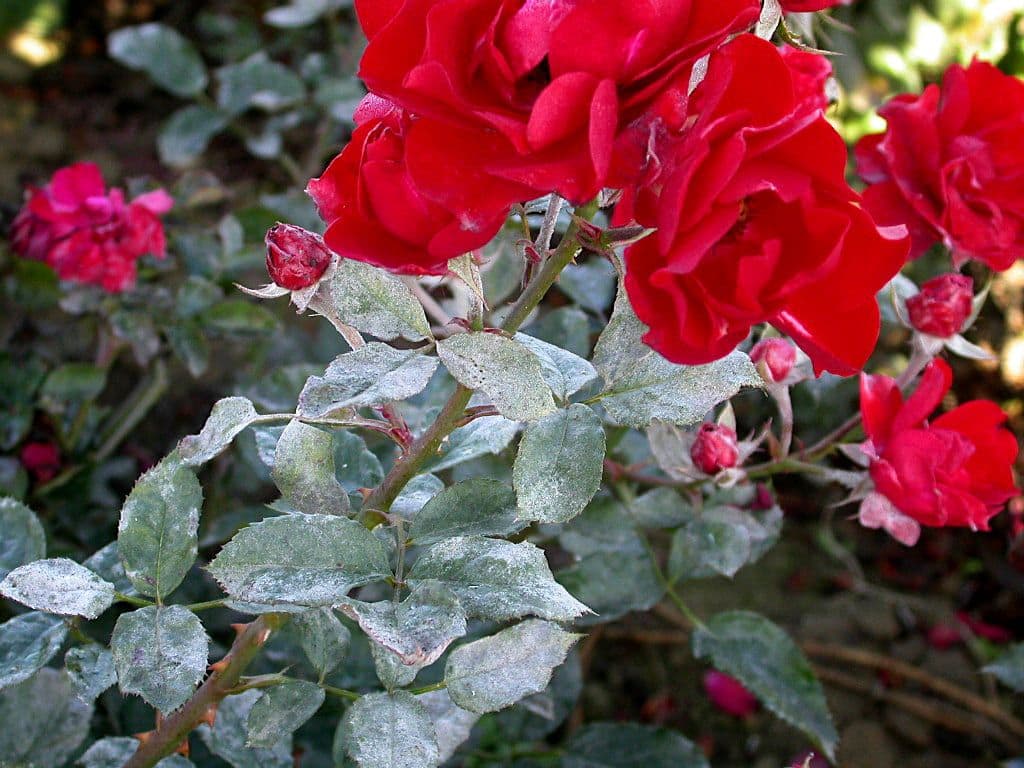
Powdery Mildew | White-to-grey growth looking like flour dusted on the leaf surface | New growth, leaves (both sides), shoot tips, flower buds | Can be wiped off, the only infection that gets worse in dry weather |
Downy Mildew | Angular, light green, yellow, purplish-red, or dark brown often “trapped” in leaf veins | Leaves, stems | Fuzzy grey-to-white mold on the underside directly under the spots (appears after them) |
Rust | Bright, orange to red pustules | Leaves underside, stems | Darken to black by late summer |
Black Spot | Black circular spots on the upper surface | Older lower leaves, stems | Underside stays completely clean |
Step-by-Step Guide on How to Treat the Plant
Treating powdery mildew on roses involves three main stages: the preparation phase, the actual treatment, and ongoing monitoring during recovery.
Step 1: Remove the Worst-Affected Parts
Prune off all affected leaves, stems, and buds. Remove all distorted or white-coated parts, no exception. In this case, trying to save as much as possible will backfire. You need to prevent the fungus from spreading to healthy foliage.
Also, don’t use any of the removed material for your homemade compost. Dispose of it in the bin or burn it to prevent further spread through your garden soil.
Step 2: Use a Suitable Fungicide or Home Treatment
There are two types of methods you can use: chemical and non-chemical.
Non-chemical methods work only as prevention, suppression, and containment. These are overhead watering to wash off spores, baking soda solutions, or horticultural oil solutions.
If you want to get rid of an infection, consider using DMI fungicides with effective active ingredients, such as myclobutanil, propiconazole, and tebuconazole. The main ingredient is typically highlighted on the packaging.
Read the instructions carefully, as application methods may vary. Most of them require 3-4 uses per season, 1 use every 10-14 days, but again, much will depend on the specific product.
Step 3: Repeat and Monitor
Monitor what happens to a plant. Note that the leaves that have already been infected will still look marked, so focus entirely on the unaffected ones. If the new growth is clean, the method you’ve chosen is working.
Take a closer look at the underside of the leaves with good lighting — that’s where the spread usually starts. Also, check if the new buds open properly.
If the problem keeps returning to the same spot in the garden every year, consider replacing the plant with a more disease-resistant rose variety.
Natural Ways to Keep the Problem Away
Of course, treating powdery mildew on roses is harder than preventing it. Here are the simple rules you can follow to protect your flowers effectively, no chemical solutions needed:
- Plant roses in a sunny place. Roses need 6-8 hours of direct sun. Avoid planting them in shade.
- Water at the base, preferably in the morning. The soil will dry out by evening, and fungi won’t spread that easily.
- Prune foliage during the dormant season. That’s how you improve airflow and reduce humidity.
- Adjust fertilization. Too much nitrogen promotes soft growth, which is especially vulnerable to fungus. Consider using more balanced, slow-release fertilizers instead.
- Do proper cleanup. Remove all leaves and other plant parts before the new season starts. Bin, don’t compost.
Also, if you’re planning to plant new roses, consider the rose cultivar resistance. Choose more resilient varieties, such as Dublin Bay, Electron, Tournament of Roses, Just Joey, and others.
FAQ
It’s safe unless you have an allergy or are sensitive to mold. In this case, it can cause irritation (coughing, sneezing, and eye discomfort). However, it’s generally harmless for both humans and pets.
Dariia Plaksina
Botanist
5 years of botanical research experience
Dariia Plaksina is a biologist, botanist, and writer of informational articles with over 5 years of experience exploring the world of plants, nature, and biology. She studied at Taras Shevchenko National University of Kyiv, Educational and Scientific Center “Institute of Biology and Medicine,” where she built a strong scientific foundation for her future work.
For Dariia, writing is a hobby, a calling, and a way to make reliable knowledge easier to understand. Her articles focus on plant care, plant health, and natural processes, helping readers learn more about the living world through clear, accessible, and science-based explanations.
Related Articles
8 min read · 1 Oct 2026
Lemon Tree Leaves Turning Yellow: Causes and How to Fix It
Yellow leaves are one of the most common lemon tree problems. This guide explains eight causes of lemon tree leaves turning yellow, from overwatering to root rot, with a fix for each.

5 min read · 16 Sept 2026
How to Keep Cats Away From Plants: 7 Safe and Effective Methods
Cats may dig in potting soil, chew leaves, or knock containers over. These seven methods combine safer placement, physical protection, a suitable chewing alternative, and play to help protect your plants without putting your cat at risk.
5 min read · 7 Sept 2026
Overwatering vs Underwatering: How to Tell the Difference
Overwatering and underwatering can look almost identical, so they're easy to confuse. In this guide, we'll cover the signs of each, simple ways to tell them apart, and how to treat your plant once you know what's wrong.
Explore Plants by Care Needs


Identify the plant and problem. Help your plant recover
Identify plant problems early, understand what's wrong, and get clear care guidance. Botan helps you turn guesswork into confident plant care