

Norfolk Island Pine Identification (Araucaria heterophylla)

Recognize Norfolk Island pine by its straight single trunk, evenly spaced horizontal branches arranged in tiered whorls, and soft awl-shaped leaves that spiral tightly around the twigs.

The crown forms a narrow, symmetrical pyramid, with each branch tier projecting in a regular, almost level pattern.

Araucaria heterophylla Identification

Identify Your Plant with Botan

Check your plant ID by uploading a clear photo to Botan.

Clear images work best. Avoid photos taken too close or too far away

Check the overall outline and branch pattern first.

  • The tree forms a narrow, symmetrical pyramid with clear horizontal tiers of branches.
  • Branches usually radiate in whorls around one straight, upright trunk, creating evenly spaced levels.
  • Branchlets are fine and feathery, held in flat sprays that give the canopy a soft texture.
  • Leaves are short, awl-shaped needles, about 0.25 to 0.5 inch (6 to 12 mm) long, packed closely around the twigs.
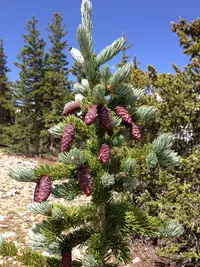
  • Cones, when present, are round to oval and sit upright on the branches rather than hanging.

A layered, symmetrical crown with soft-looking needle-covered twigs is the quickest visual clue.

Araucaria heterophylla shows clear age-related changes in foliage, branching, and overall crown shape.

  • Seedling: Young seedlings carry soft, awl-shaped leaves packed around a slender upright stem, with an initially simple outline before tiered side branches begin.
  • Juvenile plant: Juvenile plants form regular whorls of horizontal branches and a narrow pyramidal outline; leaves stay soft, curved, and needle-like, about 0.5-1 inch (1.3-2.5 cm) long.
  • Mature plant: Mature trees develop a straight trunk with widely spaced branch tiers and a broader crown; older foliage becomes shorter, thicker, and more scale-like on upper shoots.
  • Fruiting stage: Fruiting plants bear rounded cones high in the crown, much larger than the leaves, typically 4-6 inches (10-15 cm) across, adding a coarse texture.

A few conifers are regularly mistaken for Norfolk Island pine, especially when young.

Cook pine(Araucaria columnaris)

Often sold in the same trade because both have neat whorled branches and a soft, tiered outline. Cook pine usually has a narrower crown and the trunk often leans; Araucaria heterophylla is usually more symmetrical with wider-spaced tiers.

Paraná pine(Araucaria angustifolia)

Another Araucaria with whorled branching, so young plants can resemble it at a glance. It separates by having much longer, stiffer, sharper leaves, often 2 to 3 inches (5 to 7.5 cm) long, rather than the shorter, softer foliage.

Araucaria heterophylla is native to Norfolk Island in the southwest Pacific, between Australia, New Zealand, and New Caledonia. In the wild it occurs mainly in coastal and near-coastal forests, often on exposed headlands and slopes. That narrow native range helps with identification because a wild tree outside Norfolk Island is not likely to be truly native. Its frequent presence in windy coastal settings also fits the species often seen naturalized or planted near mild maritime coasts.

Araucaria heterophylla has a mild but meaningful safety concern because ingestion can upset the stomach, especially in pets.

  • Pets: Needles and other plant parts are reported to cause vomiting or mild gastrointestinal upset if eaten by dogs and cats.
  • Handling: The stiff, pointed leaves can scratch skin on contact, especially on dry indoor plants, but this is a physical injury risk rather than a toxic sap issue.

Not Sure About the ID?

Use Botan to compare a photo and help identify or confirm the plant before you label it incorrectly.

FAQ

Yes. This plant is usually identified by its straight central trunk, evenly spaced whorled branches, and soft, awl-like juvenile leaves packed around the twigs. Indoor specimens rarely produce cones, so identifying Norfolk Island Pine often relies on branching structure.

More Plant Identification Guides

One Photo. More About Your Plant.

Identify it from a photo with Botan, then get plant details, care information, and common problems for that species.

Botan app identifying a plant from a photo
12 Best Landscaping Trees for Your Garden

8 min read · 6 Oct 2026

12 Best Landscaping Trees for Your Garden

Choosing the landscape tree depends on what your garden needs most. These 12 options include compact flowering specimens, colorful deciduous trees, shade varieties, and evergreens suitable for screening and year-round structure.

Plant Recommendations
12 Best Landscaping Trees for Your Garden
Best Water for Plants – How to Choose the Right Type

7 min read · 13 Aug 2026

Best Water for Plants – How to Choose the Right Type

Rainwater, filtered, distilled, and tap water affect plants differently. Learn which types support healthy growth and which cause slow damage. Match each to your plants and discover how to easily improve tap water quality.

Plant Care
Best Water for Plants – How to Choose the Right Type
Plants That Repel Bugs – 20 Effective Options

12 min read · 16 Jul 2026

Plants That Repel Bugs – 20 Effective Options

Mosquitoes on the patio? Gnats in the kitchen? Some plants keep them away with the scent of their own leaves. Here are 20 that deal with mosquitoes, flies, aphids, and more, plus where to put them so they help.

Plant Recommendations
Plants That Repel Bugs – 20 Effective Options