
Swamp milkweed Identification (Asclepias incarnata)

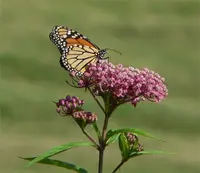
Recognize Swamp milkweed by its upright, branching stems, opposite to whorled narrow lance-shaped leaves, and rounded clusters of small pink to mauve flowers held near the stem tips.

Plants usually form clumps about 3 to 5 feet (0.9 to 1.5 m) tall, with leaves 3 to 6 inches (8 to 15 cm) long.

Asclepias incarnata Identification

Check Your Plant with Botan

Take or upload a photo to confirm your plant ID with Botan.

Clear images work best. Avoid photos taken too close or too far away

  • 1 free identification
  • No sign-up
  • 30,000+ plants in database

Check the leaf pairs, flower clusters, and pods on Asclepias incarnata.

  • Leaves are opposite, narrow lance-shaped, and usually 3-6 inches (8-15 cm) long with pointed tips.
  • Stems are upright, mostly unbranched, and often form a clump about 3-5 feet (0.9-1.5 m) tall.
  • Flower heads sit at stem tips and upper leaf joints in rounded clusters of many small pink to mauve flowers.
  • Each flower shows five reflexed petals and a raised central crown.
  • Seed pods are smooth, slender, and spindle-shaped rather than warty or strongly inflated.

Use several traits together, especially opposite leaves, pink flower clusters, and smooth narrow pods.

Asclepias incarnata shows clear visual shifts from early shoots to pods and seed release.

  • Young plant: Early shoots are upright and sparingly branched, with opposite to whorled narrow leaves that already show the species’ long, lance-shaped outline.
  • Mature plant: The plant forms a taller clump, often 3-5 feet (0.9-1.5 m) high, with multiple slender stems and more regular upper branching.
  • Flowering stage: Stem tips carry rounded clusters of many small pink to rose flowers, making the upper plant broader and more conspicuous than before blooming.
  • Fruiting stage: After flowering, clusters give way to narrow, upright seed pods that stand out against the leaves and replace the soft, rounded flower-head outline.

Swamp milkweed has a few named selections with stable flower-color or stature differences that are easy to see in the garden.

  • 'Cinderella': Flowers are a softer clear pink than the typical rosy mauve, often on plants about 3 to 4 feet (0.9 to 1.2 m) tall.
  • 'Ice Ballet': Flower clusters are white instead of pink to mauve, making it the most distinct color form.
  • 'Soulmate': Flowers are deeper rose-pink to reddish pink, usually carried on upright stems around 3 to 4 feet (0.9 to 1.2 m) tall.
  • 'Baby Joe': A shorter selection, often about 2 to 3 feet (0.6 to 0.9 m) tall, with pink flower clusters on a denser, more compact clump.

In spring, Swamp milkweed emerges as upright shoots with narrow, lance-shaped leaves. By mid to late summer, the plant is easiest to recognize when rounded clusters of pink to rose flowers sit above the foliage. After flowering, slender seed pods become visible and mature into fall. Once frost kills back the top growth, the plant disappears to the ground, leaving dry, bare stems or no obvious above-ground growth in winter.

A few pink-flowered wetland perennials can be mistaken for Swamp milkweed.

Joe-Pye weed(Eutrochium purpureum)

Often confused at a distance because both are upright and carry dusty pink flower clusters. Joe-Pye weed has many tiny fuzzy flower heads in domed clusters and leaves in whorls of 3 to 5. It lacks the distinct milkweed pods.

obedient plant(Physostegia virginiana)

Similar in height and flower color, especially before close inspection. Obedient plant bears tubular flowers in narrow spikes, not rounded clusters, and its leaves are opposite with coarse teeth. Asclepias incarnata has smoother-edged, narrower leaves.

Asclepias incarnata is native to much of eastern and central North America, from southern Canada through much of the eastern United States and into parts of the Great Plains. It is most often found in wetlands: marshes, wet meadows, streambanks, pond edges, ditches, and other low, moist ground. That habitat is a useful identification clue, because this species is far more likely in consistently wet sites than many other milkweeds.

  • Toxic if eaten: Asclepias incarnata contains cardiac glycosides in its leaves, stems, and milky sap. Ingestion can be harmful to humans and pets.
  • Sap contact: The milky sap can irritate skin in some people during handling or cutting. This is a skin-contact risk rather than an ingestion risk.

Check Your Plant ID

Use Botan to compare a photo and help confirm the plant, so you can make better decisions before buying, planting, or labeling it.

FAQ

The strongest clue is the flower cluster: many small pink to mauve flowers in rounded to flat-topped umbels, plus narrow lance-shaped leaves arranged opposite or in whorls on upright stems.

Everything About Swamp milkweed

More Plant Identification Guides

Identify Your Plant with Botan

Snap a photo to identify it, then get plant details, care information, and common problems for that species.

Botan app identifying a plant from a photo
What Plants Don't Like Epsom Salt?

11 min read · 29 Jul 2026

What Plants Don't Like Epsom Salt?

Learn which plants can be seriously damaged by Epsom salt and which will thrive on it. We’ll explain when and how to use it properly, provide tips for indoor & outdoor plants — read on and enjoy a healthy garden.

Plant Care
What Plants Don't Like Epsom Salt?
12 Best Plants That Repel Spiders For Your Home and Garden

8 min read · 24 Jul 2026

12 Best Plants That Repel Spiders For Your Home and Garden

Spiders constantly appear in places you don't want them. A few common plants can help repel them using scent alone. Here are 12 options suitable for both indoors and outdoors, plus care tips for each.

Plant Recommendations
12 Best Plants That Repel Spiders For Your Home and Garden
How to Water Houseplants: Watering Guide

7 min read · 24 Aug 2026

How to Water Houseplants: Watering Guide

Learn how often to water indoor plants, key factors for proper watering, and how to adjust the care routine by plant type, season, pot size, light, and indoor conditions.

Plant Care
How to Water Houseplants: Watering Guide