Control Spreading Edges
Once or twice a year, spade a shallow edge trench (5–8 cm deep) around beds or paths to stop runners from rooting where they are not wanted, then replant healthy cut sections in gaps you want to fill.

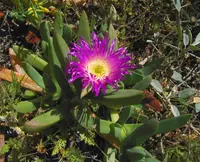
Carpobrotus chilensis, commonly called ice plant or sea fig, is a low-growing succulent groundcover known for its thick, triangular leaves and large, daisy-like flowers. It often forms dense mats that stabilize sandy soils.
This species is native to coastal areas of Chile and western South America and is now naturalized in many mild, maritime climates. It is adapted to wind, salt spray, and poor, sandy substrates.
The plant is generally easy to maintain because it tolerates drought, salt, and nutrient-poor soil, but it dislikes heavy, waterlogged ground. Understanding how to care for ice plant starts with providing strong light and very well-drained soil.

Care Difficulty
Easy Care

Light Preference
Full Sun

Water Requirements
Low Water

Temperature Preference
Tropical / Frost Sensitive

Hardiness Zone
9–11

Soil Texture
Sandy, Loamy, Rocky

Soil pH
Slightly acidic (6.5–7.0), Slightly alkaline (7.0–7.5)

Soil Drainage
Well-drained

Fertilization
Minimal (feed rarely)
Scan your plant to receive care tips personalized for your specific plant
Available on iOS and Android
This coastal succulent thrives in bright, direct light and is best placed in full sun conditions.
This drought-adapted groundcover prefers infrequent, deep watering in sharply drained soil.
This species prefers mild, frost-free climates and tolerates considerable summer heat once established.
Humidity is rarely a limiting factor for this coastal succulent.
This species prefers very free-draining, sandy substrates that mimic coastal dunes.
This species can be grown successfully in containers outdoors.
Carpobrotus chilensis is a low-nutrient coastal succulent that needs only light feeding in most garden soils.
Pruning helps maintain shape and control the spread of Carpobrotus chilensis in garden beds and slopes.
This species is more often transplanted in the landscape than kept long term in containers.
Carpobrotus chilensis is commonly propagated vegetatively to match the parent plant and cover ground quickly.
In mild coastal climates this succulent usually needs minimal winter care but is sensitive to hard frost.

Plant Health Check
Not sure what's wrong with your plant? Check your plant's health inside the app.
This species is naturally found along sandy and rocky Pacific coastlines from central California into Baja California, where it stabilizes dunes and low bluffs with its extensive, creeping root and stem system.
The flowers typically open a bright magenta to purple and often fade toward pinkish tones as they age, a change linked to pigment breakdown in the petals under strong sun and heat.
In regions where it overlaps with related Carpobrotus species, it can form hybrids, which complicates identification in the field and may increase its invasive potential in some coastal habitats.

On parts of the California coast, dense mats of Carpobrotus chilensis and its hybrids have been documented to alter soil chemistry by increasing organic matter and salt content around their roots, which can gradually disadvantage some native dune plants adapted to nutrient-poor, shifting sands.
Lack of flowers usually comes from too much shade, excess nitrogen fertilizer, or pruning at the wrong time. Full sun, lean sandy soil, and minimal feeding support strong flowering. Avoid cutting newer growth right before the blooming season.
Keep your plants happy and healthy with plant identification, disease detection, and easy care guidance.