Train New Vines
As shoots reach 20–30 cm, loosely tie them to the support with soft garden ties or twine, spacing ties every 20–30 cm to prevent wind damage and encourage an even, well-covered trellis.

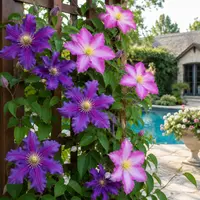
Clematis 'Jackmanii' is a vigorous deciduous climbing vine known for its large, deep purple flowers that appear in early to mid-summer. It is often grown on trellises, fences, or arches, where its twining leaf stalks readily cling to supports.
This cultivar was developed in cultivation, but clematis species are native to temperate regions of the Northern Hemisphere. It has a reputation as one of the more reliable large-flowered clematis, though it still needs proper planting and pruning.
Once established, it can be long-lived and floriferous, provided it receives enough light, consistent moisture, and well-drained soil. Basic knowledge of how to care for Clematis makes growing this plant more straightforward for most gardeners.

Care Difficulty
Moderate Care

Light Preference
Full Sun

Water Requirements
Regular Water

Temperature Preference
Cold Hardy

Hardiness Zone
4–9

Soil Texture
Loamy, Sandy, Organic-rich

Soil pH
Acidic (5.5–6.5), Slightly acidic (6.5–7.0)

Soil Drainage
Moist but well-drained

Fertilization
Light (every 4–6 weeks)
Scan your plant to receive care tips personalized for your specific plant
Available on iOS and Android
This large-flowered climber performs best with plenty of sun on the vines and shaded, cool roots.
This vine prefers evenly moist, cool soil that never stays waterlogged.
This hardy climber tolerates cold winters but grows and flowers best in moderate temperatures.
Humidity is rarely a limiting factor for Clematis 'Jackmanii' in typical outdoor conditions.
Clematis 'Jackmanii' prefers deep, moisture-retentive but free-draining soil that stays cool around the roots.
This clematis can grow successfully in large outdoor containers when root space and stability are carefully managed.
This clematis benefits from consistent, moderate feeding during the main growing season.
Pruning supports healthy growth and abundant flowering in Clematis 'Jackmanii'.
This vigorous climber is usually grown in the ground, with transplanting done carefully and infrequently.
Propagation of Clematis 'Jackmanii' is usually done vegetatively to maintain the cultivar’s characteristics.
This clematis is generally cold hardy in much of the US but benefits from simple root-zone protection in winter.

Plant Health Check
Not sure what's wrong with your plant? Check your plant's health inside the app.
This cultivar, introduced in the 1860s by British nurseryman George Jackman, was among the first reliably hardy large-flowered clematis hybrids and helped launch the modern popularity of garden clematis in Europe and North America.
Unlike many early large-flowered clematis that bloom mainly in spring, this vine produces a main flush of deep purple flowers in early summer and then continues to rebloom sporadically into early fall on the same season’s growth.
Plant breeders have used this hybrid extensively in crossing programs, so its genetics appear in a wide range of later large-flowered cultivars, shaping much of today’s garden clematis assortment and informing modern Clematis 'Jackmanii' care instructions.

Historic specimens of this hybrid planted in 19th-century European gardens have been documented surviving for several decades in the same location when grown on suitable supports and managed with consistent pruning, making it one of the more enduring ornamental climbers in traditional estate plantings.
Poor flowering often comes from too much shade, heavy pruning at the wrong time, or nutrient imbalance. Ensure strong light, avoid cutting all old stems in late winter, and use a balanced, low-nitrogen fertilizer for reliable blooms.
Keep your plants happy and healthy with plant identification, disease detection, and easy care guidance.