



Snake plant Identification (Dracaena trifasciata)

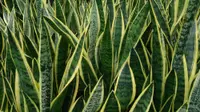
To recognize Snake plant, look for stiff, upright, sword-shaped leaves that rise directly from the base in dense clumps, with no woody trunk. Leaves are thick and flat, usually 1-4 inches (2.5-10 cm) wide.

Each leaf stands mostly vertical and tapers to a firm point, creating a tight, strongly upright growth pattern.

Dracaena trifasciata Identification

Check Your Plant with Botan

Check your plant ID by uploading a clear photo to Botan.

Clear images work best. Avoid photos taken too close or too far away

Check the plant’s leaf shape, arrangement, and base growth first.

  • Leaves are stiff, upright, and sword-shaped, usually 1-4 feet (30 cm-1.2 m) long and a few inches wide.
  • Each leaf rises directly from the base in a tight clump or fan, with no visible branching stems or trunk above the soil.
  • Leaf surfaces show horizontal gray-green banding, and the blades are thick, flat to slightly channeled, with pointed tips.

A dense basal clump of tall, rigid leaves is a strong visual match.

Snake plant shows a few useful visual changes as rosettes age and reproduce.

  • Juvenile plant: Leaves are shorter, narrower, and held in a tighter upright fan, with the rosette close to the soil and little outward spread.
  • Young plant: The clump begins producing offsets from underground rhizomes, so separate leaf fans appear beside the first rosette and widen the overall footprint.
  • Mature plant: Established clumps carry stiffer swordlike leaves often 2-4 feet (0.6-1.2 m) tall, with multiple crowded rosettes arising from the same base.
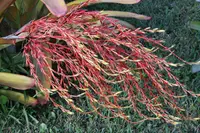
  • Flowering stage: A mature rosette may send up a slender leafless stalk bearing many small pale tubular flowers in clusters, standing above the foliage.

Snake plant has several well-established cultivars that are easy to separate by leaf shape and variegation.

  • 'Laurentii': Leaves have a clear yellow margin around the green, gray-banded center; the upright blades are typically 2-4 inches (5-10 cm) wide.
  • 'Hahnii': Forms a low bird’s-nest rosette instead of tall upright fans, usually staying under 12 inches (30 cm) tall.
  • 'Moonshine': Leaves are a pale silvery green with much fainter horizontal banding than the typical form.
  • 'Bantel's Sensation': Leaves are narrower and marked with lengthwise white stripes, giving a more vertically striped look than the usual cross-banding.
  • 'Cylindrica': Leaves are round in cross section and spear-like rather than flat, often held in a more separated, architectural clump.

Seasonal clues are limited, but flowering can briefly aid identification. Snake plant may send up a tall flower stalk in spring to early summer, bearing clusters of small, pale greenish-white to cream flowers. For most of the year, the leaf rosette looks much the same. There is no regular seasonal leaf drop, bare-stem phase, or reliable seasonal color shift that helps with identification.

A few upright, strap-leaved plants are regularly mistaken for snake plant.

Bowstring hemp(Dracaena hyacinthoides)

Often confused because it forms stiff, upright rosettes with banded leaves. It usually has broader leaves with wavy margins and a deeper channel along the leaf, while Dracaena trifasciata more often shows flatter, sword-like leaves with crisper cross-banding.

East African dragon tree(Dracaena angolensis)

Confusion happens when juvenile plants are sold in small pots, since both have succulent, upright leaves. D. angolensis has cylindrical, spear-like leaves and a fan arrangement; D. trifasciata has flat leaves arising in a basal rosette.

Dracaena trifasciata is native to tropical West Africa, with reliable records centered in Nigeria east to the Congo region. In the wild it occurs on dry rocky ground and in open woodland or thicket rather than deep rainforest. That setting is a useful clue because it helps separate this species from tropical understory plants that need constant shade and moisture. Finding a stiff-leaved Dracaena linked to seasonally dry, rocky African habitats supports identification.

  • Ingestion toxicity: The leaves contain saponins. If eaten, they can cause stomach upset in humans and pets, especially cats and dogs. Typical effects include nausea, vomiting, drooling, and diarrhea.
  • Sap contact: Leaf sap can irritate skin in some people after direct contact, so the concern is mainly skin exposure rather than handling the dry leaf surface.

Check Your Plant ID

Use Botan to identify or confirm it from a photo, which helps avoid mix-ups with similar houseplants.

FAQ

The clearest trait is its stiff, upright, sword-shaped leaves arising from the base in a tight clump. Leaves are thick, smooth-edged, and usually banded crosswise in gray-green and darker green, a strong cue for Snake plant identification.

More Plant Identification Guides

Identify Your Plant with Botan

Snap a photo to identify it, then get species-specific care information, safety notes, and common problems.

Botan app identifying a plant from a photo
12 Best Landscaping Trees for Your Garden

8 min read · 6 Oct 2026

12 Best Landscaping Trees for Your Garden

Choosing the landscape tree depends on what your garden needs most. These 12 options include compact flowering specimens, colorful deciduous trees, shade varieties, and evergreens suitable for screening and year-round structure.

Plant Recommendations
12 Best Landscaping Trees for Your Garden
Thorny Plants: A Comprehensive Guide

10 min read · 25 Aug 2026

Thorny Plants: A Comprehensive Guide

Many plants defend themselves with sharp thorns. This guide explores over 20 examples among flowers, shrubs, trees, and vines. You'll learn what each plant looks like, why it grows thorns, and how to quickly identify them.

Plant Recommendations
Thorny Plants: A Comprehensive Guide
Rice Water for Plants – Which Plants Love It and How to Make It

8 min read · 14 Jul 2026

Rice Water for Plants – Which Plants Love It and How to Make It

Rice water can be an ideal DIY solution for orchids, roses, or fruiting plants. It supports growth, leaf count, and height. We’ll share how to make and apply it correctly for your plant.

Plant Care
Rice Water for Plants – Which Plants Love It and How to Make It