



catnip Identification (Nepeta cataria)

To recognize catnip, look for opposite pairs of heart- to triangular-shaped leaves with rounded teeth, carried on square, upright stems. Plants usually form a loose, branching clump about 2-3 feet tall (60-90 cm).

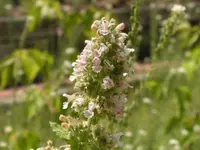
The flowers appear in short whorls along the upper stems, with small white, two-lipped blooms often marked with purple spots.

Nepeta cataria Identification

Check Your Plant with Botan

Check your plant ID by uploading a clear photo to Botan.

Clear images work best. Avoid photos taken too close or too far away

Use these quick visual checks for Nepeta cataria.

  • Upright, branching herb with square stems, usually 2-3 feet (60-90 cm) tall.
  • Leaves grow in opposite pairs; blades are heart-shaped to triangular with coarse, rounded teeth.
  • Leaf surfaces look softly hairy and slightly gray-green; most leaves are about 2-3 inches (5-8 cm) long.
  • Small tubular flowers sit in dense whorls near stem tips, usually white with purple spots on the lower lip.

Check several stems, since the square stems and opposite leaves are easiest to confirm together.

Nepeta cataria shows clear visual shifts from early leafy growth to flowering and seed set.

  • Seedling: Seedlings show opposite first leaves and short stems; early true leaves are small, softly hairy, and already triangular to heart-based with scalloped edges.
  • Young plant: Before flowering, the plant forms a leafy clump with square stems, paired gray-green leaves, and stronger branching; plants often stand 12-24 inches (30-60 cm) tall.
  • Flowering stage: Upper stems lengthen into spaced whorls of small white flowers marked with purple spots, changing the outline from leafy clump to open, upright spikes.
  • Fruiting stage: After bloom, flowers dry into persistent calyces that hold four tiny nutlets, while the stems keep their vertical, branched framework and a less leafy look.

In spring, catnip sends up fresh, soft green shoots with opposite, scalloped leaves. By early to mid-summer, the plant is easier to spot when small white to pale lavender flowers appear in short clusters at the upper leaf nodes. After flowering, the dried flower clusters and seed-bearing calyces often persist for a time. In cold winter conditions, top growth commonly dies back, leaving little or no leafy growth visible.

Several mint-family plants are mistaken for catnip.

catmint(Nepeta × faassenii)

Shares gray-green, aromatic leaves and lavender flowers. Usually forms a tidier, lower mound, with smaller leaves and denser flower spikes than the taller, looser habit of Nepeta cataria.

lemon balm(Melissa officinalis)

Has opposite, toothed, softly wrinkled leaves like catnip. Flowers are small, whitish, and tucked in leaf axils, not showier lavender spikes; crushed leaves smell lemony.

white horehound(Marrubium vulgare)

Another fuzzy, opposite-leaved mint relative. Leaves are rounder and more heavily crinkled, and the white flowers cluster in tight whorls at stem nodes rather than elongated terminal spikes.

Nepeta cataria is native to parts of Europe, Asia, and likely the Near East. It is typically found in disturbed ground, field edges, roadsides, waste places, and other open, sunny sites rather than in forest understories, wetlands, or alpine habitats. That setting helps with identification because true catnip often appears in dry, human-influenced places. Finding a mint-family plant in open, weedy ground supports Nepeta cataria more than shade-loving or marsh species.

Scan. Check. Confirm.

Use Botan to identify or verify the plant from a photo, which helps avoid mix-ups before you label it or compare details.

FAQ

The strongest clue is the leaf-and-stem combination: opposite, heart-based, softly hairy, gray-green leaves with scalloped edges on distinctly square stems. Crushing a leaf releases a minty, slightly skunky scent that helps with catnip identification.

More Plant Identification Guides

From Plant ID to Plant Info

Identify a plant from a photo with Botan, then review plant details, care information, and common problems for the matched species.

Botan app identifying a plant from a photo
How to Mist Plants – Proper Technique and Common Mistakes

7 min read · 30 Jul 2026

How to Mist Plants – Proper Technique and Common Mistakes

Find out when misting works well and when to avoid it. Here, you’ll find detailed information about compatible and incompatible species, tips on how often to mist plants and do it correctly, and some great alternatives for raising humidity.

Beginner Guides

How to Mist Plants – Proper Technique and Common Mistakes
How Fast Does Bamboo Grow Per Day, Month, and Year

10 min read · 7 Jul 2026

How Fast Does Bamboo Grow Per Day, Month, and Year

Bamboo grows extremely fast: some species can reach 5-6 m in just 3-4 months under the right conditions. This guide explains how much bamboo can grow per day, week, and year, and what affects its growth rate.

Plant Recommendations
How Fast Does Bamboo Grow Per Day, Month, and Year
12 Best Plants That Repel Spiders For Your Home and Garden

8 min read · 24 Jul 2026

12 Best Plants That Repel Spiders For Your Home and Garden

Spiders constantly appear in places you don't want them. A few common plants can help repel them using scent alone. Here are 12 options suitable for both indoors and outdoors, plus care tips for each.

Plant Recommendations
12 Best Plants That Repel Spiders For Your Home and Garden