Install sturdy supports
Place ring-style or grid peony supports over the clump in early spring when shoots are 10–15 cm tall so the heavy double flowers are held upright and do not snap in wind or rain.

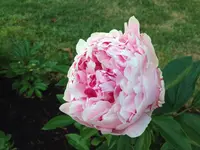
Paeonia lactiflora 'Sarah Bernhardt' is a classic herbaceous perennial peony, valued for its large, fragrant, soft pink double flowers. Plants form rounded clumps of divided green foliage that die back to the ground in winter and re-sprout each spring.
This cultivar originates from garden selections of East Asian peonies, now widely grown in temperate regions for long-lived borders and cutting gardens. It is considered relatively easy for gardeners who provide winter chill, full sun, and moist, well-drained soil.
Understanding how to care for Peony starts with knowing it dislikes waterlogged conditions and deep planting, but otherwise becomes a dependable, long-term feature in the landscape.

Care Difficulty
Moderate Care

Light Preference
Full Sun

Water Requirements
Moderate Water

Temperature Preference
Cold Hardy

Hardiness Zone
3–8

Soil Texture
Loamy, Silty, Organic-rich

Soil pH
Acidic (5.5–6.5), Slightly acidic (6.5–7.0)

Soil Drainage
Moist but well-drained

Fertilization
Minimal (feed rarely)
Scan your plant to receive care tips personalized for your specific plant
Available on iOS and Android
This cultivar thrives in bright outdoor conditions with several hours of direct sun each day.
Watering should support deep root growth while avoiding waterlogged soil.
This perennial prefers cool to moderate temperatures and benefits from cold winters.
Humidity is not a significant factor for Paeonia lactiflora 'Sarah Bernhardt' grown outdoors in typical garden conditions in temperate climates.
Paeonia lactiflora 'Sarah Bernhardt' prefers deep, well-structured soil that drains freely but retains steady moisture.
This peony can be grown in containers, but it performs best in large, stable, outdoor pots with careful moisture management.
This long-lived perennial benefits from modest, well-timed feeding rather than heavy fertilization.
Pruning focuses on hygiene and managing spent growth rather than reshaping Paeonia lactiflora 'Sarah Bernhardt'.
This peony is usually grown in-ground and dislikes frequent disturbance, so transplant only when clearly needed.
Division is the standard, slow-frequency method for increasing Paeonia lactiflora 'Sarah Bernhardt'.
This herbaceous peony is very cold hardy and usually needs only simple winter preparation.

Plant Health Check
Not sure what's wrong with your plant? Check your plant's health inside the app.
This cultivar is known for its very full double flowers, where most or all reproductive parts are transformed into extra petals, creating the densely packed, ruffled appearance prized in traditional cut flower production.
Among herbaceous peonies, it is a relatively late bloomer, often extending the peony flowering season by opening after many early and mid-season cultivars have finished.
Introduced in the early 1900s, it has remained one of the most widely grown commercial peony cultivars for more than a century due to its stable color, stem length, and good vase performance when harvested in the correct bud stage, making it a textbook reference in Paeonia lactiflora 'Sarah Bernhardt' plant care for cut-flower growers.

This cultivar received the Royal Horticultural Society’s Award of Garden Merit, which indicates that extensive trials under UK conditions confirmed its reliability, ornamental value, and relative freedom from serious pests and diseases compared with many other peonies.
Lack of flowering is usually due to planting too deep, too much shade, or plants divided/relocated recently. Immature clumps, excess nitrogen fertilizer, or late frosts damaging buds also reduce blooms in this cultivar.
Keep your plants happy and healthy with plant identification, disease detection, and easy care guidance.