

Primrose Identification (Primula vulgaris)

To recognize Primula vulgaris, look for a low basal rosette of wrinkled, oblong to spoon-shaped leaves and leafless flower stalks rising singly from the center.

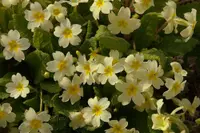
Each flower has five broad lobes around a small yellow eye, usually about 1 to 1.5 inches (2.5 to 4 cm) across.

Primula vulgaris Identification

Identify Your Plant with Botan

Not sure about your plant ID? Upload a photo and check it with Botan.

Clear images work best. Avoid photos taken too close or too far away

  • 1 free identification
  • No sign-up
  • 30,000+ plants in database

Check Primula vulgaris for a low basal rosette and single, open flowers held just above it.

  • Leaves form a ground-level rosette, not along upright stems.
  • Leaf blades are oblong to spoon-shaped, about 2-10 inches (5-25 cm) long, with wrinkled surfaces and rounded, toothed edges.
  • Each flower is solitary on its own short stalk and usually has 5 broad lobes around a small yellow center.
  • Flowers are about 1-2 inches (2.5-5 cm) across and sit close to the leaves rather than in tall clusters.

Look for the combination of a leaf rosette and one flower per stalk.

Primula vulgaris shows clear visual shifts from basal rosette growth to flowering and fruiting.

  • Seedling: Seedlings show a tiny basal rosette of soft, spoon-shaped leaves with shallowly toothed edges; no true flowering stalk is present at this stage.
  • Young plant: The rosette broadens and leaves become wrinkled and more oblong, with a clearer midrib; plants remain low, usually under 4 inches (10 cm).
  • Flowering stage: Single flowers rise above the leaf rosette on separate leafless stalks; each bloom has five broad lobes and a flat, open face.
  • Fruiting stage: After flowering, the corolla drops and an upright green capsule remains at the stalk tip, enclosed at the base by the persistent calyx.

Primrose has several long-recognized forms and cultivars that are easy to separate by flower structure or color.

  • Primula vulgaris f. sibthorpii: Differs from the typical pale yellow form by clear pink to rosy-lilac flowers, usually with a yellow eye.
  • Primula vulgaris 'Oakleaf Yellow Picotee': Shows deeply cut, oak-like leaves instead of the usual rounded, crinkled rosette leaves; flowers are yellow with a fine darker edge.
  • Primula vulgaris 'Belarina Cream': Has fully double, rose-like cream-yellow flowers rather than the normal single, five-petaled blooms.

Primula vulgaris is most recognizable from late winter into spring, when pale yellow flowers appear singly on short stalks above a low rosette of wrinkled green leaves. This early flowering display is one of the clearest seasonal clues. After flowering, the blooms fade and small seed capsules develop near the leaf rosette. The plant keeps its basal leaves, but without flowers it is less distinctive at a glance.

Several spring flowers can be mistaken for Primrose at a glance.

cowslip(Primula veris)

Often confused because both make basal leaf rosettes and soft yellow flowers. Cowslip carries many nodding blooms in an umbel on one leafless stalk, while Primula vulgaris usually has single flowers on separate short stalks. Its leaves are also narrower and more wrinkled.

oxlip(Primula elatior)

Similar in leaf rosette and pale yellow flowers. Oxlip lifts several flowers together above the leaves on one stalk, instead of mostly solitary flowers close to the foliage. The flowers are usually smaller and face outward or slightly nod downward.

Primula vulgaris is native to western and southern Europe, extending into parts of North Africa and western Asia. In the wild it is most often found in deciduous woodland, hedgebanks, shaded meadows, and damp grassy slopes. This habitat helps with identification because true wild plants are usually encountered in cool, moist, partly shaded places rather than dry open ground. Finding it in ancient woodland edges or unimproved grassland can help separate it from planted garden primroses.

Primula vulgaris can cause problems by skin contact and by ingestion. The main concern is primin, an irritant in the leaves and stems.

  • Skin contact: Leaves and stems can trigger allergic contact dermatitis in people. This is a skin reaction with redness, itching, or blistering after handling the plant.
  • Ingestion: Plant parts are considered mildly toxic if eaten by humans or pets, with the main risk being stomach upset.

Confirm the Species with Botan

Upload a photo to compare key details and help verify the plant before you label it or look up more information.

FAQ

Leaves grow in a basal rosette, meaning they all arise from the plant’s base rather than along an upright stem. This low circular cluster is a useful starting point for Primula vulgaris identification.

More Plant Identification Guides

Find Out What Plant It Is

Use Botan to identify a plant from a photo, then get plant details, care information, and common problems for that species.

Botan app identifying a plant from a photo
12 Best Plants for Bathroom That Thrive in Humid Conditions

9 min read · 29 Sept 2026

12 Best Plants for Bathroom That Thrive in Humid Conditions

Discover the 12 best plants for bathroom spaces. Each pick comes with its own advantages, plus light, humidity, watering, and placement tips. Take a look and match the plant to your specific bathroom.

Plant Recommendations
12 Best Plants for Bathroom That Thrive in Humid Conditions
Is Sugar Water Good for Plants?

4 min read · 14 Sept 2026

Is Sugar Water Good for Plants?

Sugar water may sound like an easy boost, but most rooted plants do not need extra sucrose. This guide explains how green tissues produce carbohydrates, when a sweetened solution can be useful, and why too much can cause problems.

Plant Care
Is Sugar Water Good for Plants?
How Fast Does Bamboo Grow Per Day, Month, and Year

10 min read · 7 Jul 2026

How Fast Does Bamboo Grow Per Day, Month, and Year

Bamboo grows extremely fast: some species can reach 5-6 m in just 3-4 months under the right conditions. This guide explains how much bamboo can grow per day, week, and year, and what affects its growth rate.

Plant Recommendations
How Fast Does Bamboo Grow Per Day, Month, and Year