white oak Care (Quercus alba)

Also known as: eastern white oak, stave oak
white oak

About white oak

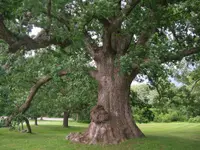
White oak, Quercus alba, is a long-lived deciduous tree native to eastern and central North America. It is known for its broad, rounded crown and strong, heavy wood.

Mature trees develop thick, light gray bark and deeply lobed leaves that turn red or purple in fall. The tree produces acorns that support many wildlife species.

This species prefers full sun, well-drained, slightly acidic to neutral soils, and consistent moisture in its early years. Once established, it becomes relatively tolerant of moderate drought.

For anyone learning how to care for white oak, the main challenges are providing enough space for its mature size and avoiding poorly drained or compacted soils.

Main Plant Requirements

Care Difficulty

Moderate Care

Light Preference

Full Sun

Water Requirements

Moderate Water

Temperature Preference

Cold Hardy

Hardiness Zone

3–9

Soil Texture

Sandy, Loamy, Clay

Soil pH

Acidic (5.5–6.5), Slightly acidic (6.5–7.0)

Soil Drainage

Moist but well-drained

Fertilization

Minimal (feed rarely)

Get Personalized Care Plan

Scan your plant to receive care tips personalized for your specific plant

Available on iOS and Android

How to Care for the white oak

This large deciduous tree develops best with abundant direct light that mimics an open woodland or field edge.

  • Provide full sun for 6–8+ hours per day; young trees can tolerate 3–4 hours of very light afternoon shade, especially in hotter regions.
  • Site white oak where it receives morning to midafternoon sun; avoid deep shade, which causes sparse branching, slower growth, and thinner crowns.
  • In the first 2–3 years, protect from intense reflected heat from pavement or walls to reduce leaf scorch and water stress during summer.

This species prefers deep, infrequent watering that encourages a strong taproot and drought resilience.

  • During the first 2–3 growing seasons, water when the top 5–8 cm of soil feels dry, soaking the root zone to 20–30 cm depth each time.
  • Ensure soil drains freely; prolonged standing water, sour smell, or soft, blackened roots indicate overwatering and raise risk of root rot.
  • Mature Quercus alba usually manages seasonal drought but shows underwatering through dull, curling, or prematurely browning leaves, especially in late summer.

This hardy oak is adapted to temperate climates with cold winters and warm to hot summers.

  • Active growth occurs best around 60–80°F (16–27°C) during spring and early summer when soil is evenly moist.
  • The tree tolerates winter lows near -20°F (-29°C) once established, with dormancy protecting buds and branches from typical frosts.
  • In heat above 90°F (32°C), combine full sun with adequate soil moisture and mulch to limit heat stress, leaf scorch, and premature leaf drop.

This species handles a wide humidity range and usually does not need special humidity management outdoors.

  • Target ambient humidity around 30–60% for young or container-grown white oak, similar to typical outdoor conditions.
  • Dry air alone rarely harms the tree, but prolonged hot, dry winds can increase leaf edge browning and drop in stressed saplings.
  • Mulch soil 5–8 cm deep and water consistently during dry spells to reduce evaporative stress rather than trying to raise air humidity.

Quercus alba performs best in deep, structured mineral soils with steady moisture and strong aeration.

  • Use a loamy or sandy-loam soil with 20–30% compost or leaf mold to supply organic matter while keeping structure firm, not spongy.
  • Ensure drainage is moderate: soil should hold moisture but drain within a few hours after heavy watering, without standing water or sour odor.
  • Aim for slightly acidic to neutral pH, roughly 5.5–7.0, and avoid high-lime or strongly alkaline fill that can lead to nutrient lockout and chlorosis.
  • For heavy clay, improve aeration and drainage by incorporating coarse sand and fine pine bark into the top 30–40 cm, avoiding complete replacement that creates a perched water table.

This species is only moderately suitable for containers and usually stays healthiest when kept as a temporary potted sapling rather than a long-term container tree.

  • Choose a container at least 45–60 cm deep to accommodate the developing taproot and reduce circling roots near the surface.
  • Use a heavy, stable pot material or add weight at the base to prevent tipping as the trunk thickens and the crown becomes wind-exposed.
  • Select a tall, narrow container ratio so root growth is directed downward, which better mimics in-ground structure and reduces root stress.

Established Quercus alba in the ground usually needs minimal fertilization if soil is reasonably fertile.

  • For young or nutrient-poor site trees, apply a balanced slow-release NPK (such as 10-10-10) in early spring.
  • Use 1/2–3/4 the label rate, spread evenly from near the trunk out to the drip line.
  • Supplement with 2–5 cm of compost over the root zone once a year, kept off the trunk.
  • Avoid feeding in late summer or fall so new growth can harden before winter dormancy.

Pruning Quercus alba focuses on structural safety and removal of defective wood rather than frequent shaping.

  • Schedule main pruning during late winter while the tree is dormant and leafless.
  • Remove dead, diseased, crossing, or storm-damaged branches using clean, sharp bypass pruners or a pruning saw.
  • Maintain a single strong central leader and well-spaced scaffold branches to support long-term structure.
  • Limit large cuts; for mature trees or near structures, use a certified arborist for safe, correct work.

Quercus alba is rarely a long-term container plant, so care centers on timely outdoor transplanting with minimal root disturbance.

  • Move container seedlings when roots begin circling the pot or growth slows despite good care.
  • Transplant in late fall after leaf drop or early spring before bud break for lower stress.
  • Shift young trees only every few years, each time into a hole 2–3× wider than the root ball, at the same soil depth.
  • Water thoroughly before and after planting, keep the root ball intact, and apply 5–8 cm of mulch to reduce shock.

Propagation of Quercus alba is typically done from seed rather than by cuttings or division.

  • Collect ripe acorns in early fall and discard any that float in water, which often indicates emptiness or decay.
  • Sow promptly outdoors or cold-stratify at 34–41°F for 60–90 days to break dormancy.
  • Plant acorns 2–5 cm deep in deep containers or nursery beds with well-drained, slightly acidic soil.
  • Keep evenly moist, protect from rodents with mesh, and avoid disturbing the taproot during the first 1–2 years.

Mature Quercus alba is very cold hardy and usually requires no special winter protection in its native range.

  • Mulch young trees with 5–8 cm of bark or wood chips over the root zone, keeping mulch a few cm from the trunk.
  • Shelter first-year seedlings from desiccating winter winds with a simple windbreak if the site is very exposed.
  • For container-grown saplings, move pots into an unheated garage or bury containers to insulate roots in colder climates.

Care Tips

Deep root establishment

During the first 3–5 years, water less often but for a longer duration to encourage deep root growth, using a slow hose soak at the dripline rather than frequent light sprinkling near the trunk.

Proper staking setup

Stake young trees only if they lean or are in a very windy site, using 2–3 stakes outside the root zone and flexible ties placed low enough to allow some trunk movement, then remove all staking within 1–2 years to prevent girdling.

Mulch ring management

Maintain a 5–10 cm deep, 60–120 cm wide mulch ring around the tree, keeping mulch pulled back 5–8 cm from the trunk to protect surface roots, conserve moisture, and reduce mower and string trimmer damage.

Root flare inspection

Ensure the root flare (the area where the trunk widens at the soil line) is visible and not buried; if covered, carefully remove excess soil or mulch by hand to reduce risk of rot and girdling roots.

Long-term space planning

When growing white oak, keep permanent structures, paving, and utility lines well outside the projected mature canopy and root zone to avoid future conflict, costly pruning, and root damage.

Common Pests and Diseases

Oak wilt

This disease is caused by a vascular fungus that blocks water movement in the tree. Symptoms include rapid leaf wilting, browning from the leaf margins inward, and sudden branch dieback, often progressing quickly through the crown.

Solution

Prune and destroy infected branches immediately and avoid pruning during the growing season to reduce spread by sap-feeding beetles. Do not move firewood from infected areas, and consult a certified arborist about possible root graft disruption and use of systemic fungicides for high‑value trees as part of broader oak wilt management.

Gypsy moth

These insects are defoliating caterpillars that feed heavily on oak leaves, especially in outbreak years. Symptoms include skeletonized or completely eaten foliage, large amounts of frass (insect droppings), and thinning crowns in early summer.

Solution

Hand-pick and destroy egg masses from bark and nearby structures during fall and winter, and use burlap bands around trunks in late spring to trap caterpillars for removal. In larger infestations, consider targeted applications of Bacillus thuringiensis kurstaki (Btk) by licensed professionals during the early caterpillar stage to protect tree foliage while minimizing non‑target effects when caring for white oak.

Oak anthracnose

This disease is a foliar fungal infection favored by cool, wet spring weather. Symptoms include irregular brown blotches on leaves, distorted or cupped foliage, and premature leaf drop from lower and inner branches.

Solution

Rake and remove fallen leaves to reduce fungal spores and improve air circulation around the canopy by selective pruning. In landscapes with repeated severe outbreaks, a professional may time preventive fungicide sprays to early leaf emergence to protect new growth.

Oak leaf blister

This disease is caused by a fungus that produces raised, blister-like swellings on leaves. Symptoms include pale, thickened patches that later turn yellow to brown, sometimes causing minor premature leaf drop but rarely serious long-term damage in healthy trees.

Solution

Collect and dispose of fallen leaves to limit overwintering spores and maintain overall tree vigor through proper watering and mulching. In sites with chronic, severe cosmetic damage on high‑value specimens, a certified arborist may apply a preventive fungicide just before budbreak, since treatments after symptoms appear are not effective.

Oak leafminer

These insects are small larvae that feed inside the leaf tissue, creating pale, winding or blotchy tunnels. Symptoms include translucent, discolored patches between leaf veins and a slightly scorched appearance when many mines are present.

Solution

Prune and destroy heavily infested twigs and promptly rake and remove fallen leaves to reduce overwintering stages. Encourage natural predators and, for severe recurring infestations, consult a professional about appropriately timed systemic treatments that target larvae inside the leaves while minimizing impact on beneficial insects.

Interesting Facts

High‑value barrel wood

White oak wood has a tight, closed-cell structure that makes it naturally water-resistant, so it is the standard species for aging whiskey, bourbon, and many wines in North America.

Specialist wildlife support

This oak hosts the larvae of many specialist moths and butterflies and produces acorns that are a key autumn food source for wildlife such as wild turkey, white-tailed deer, and several squirrel species in eastern North America.

Distinctive flaky bark

Mature white oaks develop pale gray, scaly to flaky bark with irregular plates, which helps distinguish them from many other eastern oaks that have darker, more furrowed bark.
Botan icon

Did you know?

Individual white oak trees can exceed 300 years of age, and some historically documented specimens in eastern North America have been estimated, using ring counts and historical records, at over 400 years old, making this species one of the longest-lived hardwoods in its native forests.

FAQs about white oak

This species grows slowly, typically about 30–60 cm per year in youth under good conditions. Growth rate declines with age. Deep, well-drained soil, full sun, and adequate space are important factors influencing growth.

Grow Healthy Plants with Botan Care

Keep your plants happy and healthy with plant identification, disease detection, and easy care guidance.


Botan plant care app — identify plants on mobile

Explore More Plants