


ginger Identification (Zingiber officinale)

Recognize ginger by its tight clumps of upright pseudostems, each formed by overlapping leaf bases, with narrow lance-shaped leaves arranged in two ranks along the stem.

It also has thick, branching rhizomes at the base and short flower spikes that arise separately from the ground, not from the leafy stems.

Zingiber officinale Identification

Identify Your Plant with Botan

Check your plant ID by uploading a clear photo to Botan.

Clear images work best. Avoid photos taken too close or too far away

Check the overall form first: Zingiber officinale makes upright leafy shoots from a thick underground rhizome.

  • Shoots are reed-like and unbranched, with many narrow leaves arranged in two ranks along the stem.
  • Leaves are lance-shaped, pointed, and usually about 6-12 inches (15-30 cm) long.
  • Leaf bases wrap around the stem, creating a smooth, layered pseudostem rather than a woody trunk.
  • Flower spikes, when present, rise separately from the base and form dense cone-like heads with overlapping bracts.

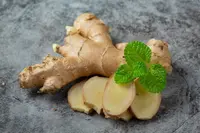
The visible rhizome is thick, knobby, and pale tan to light brown when partly exposed.

Zingiber officinale shows clear visual changes from early shoots to flowering clumps.

  • Young plant: New shoots emerge as narrow spear-like points, then open into a few slim leaves on short pseudostems, with the clump still sparse and low.
  • Mature plant: Established plants form dense upright clumps of leafy pseudostems about 3-4 feet (0.9-1.2 m) tall, with longer, broader leaves arranged in two ranks.
  • Flowering stage: Flowering stems are separate from leafy shoots and carry compact cone-like spikes near ground level, with overlapping green bracts and small pale flowers peeking between them.

In warm weather, ginger sends up fresh green leafy shoots from the rhizome, creating upright clumps. When flowering occurs, cone-like flower spikes become visible near the base rather than at the stem tips. In cooler seasons, the leafy stems can yellow, wither, and die back, leaving the plant absent above ground during dormancy. That seasonal dieback is a useful clue in regions with a marked cool or dry period.

A few rhizomatous tropicals are mistaken for ginger when not in flower.

shampoo ginger(Zingiber zerumbet)

It shares upright leafy shoots and lance-shaped leaves. The quickest check is the flower spike: shampoo ginger makes a separate pinecone-like head that turns red, while Zingiber officinale has a shorter spike arising from the base.

galangal(Alpinia galanga)

This plant also forms dense clumps of cane-like stems with narrow leaves. It is usually taller, often 6 feet (1.8 m) or more, and its leaves are broader and stiffer than the softer, narrower leaves of culinary ginger.

Not Sure About the ID?

Upload a photo to Botan to identify the plant or confirm your ID before labeling, repotting, or comparing it with similar species.

FAQ

Yes. This plant is usually identified by its aromatic, branched rhizome, upright leafy pseudostems, and narrow lance-shaped leaves arranged in two ranks. Fruit is rarely seen in cultivation, so ginger plant identification often relies on vegetative features.

More Plant Identification Guides

Identify Your Plant and Learn More

Upload a photo to identify it with Botan, then get plant details, care information, and common problems for that species.

Botan app identifying a plant from a photo
20 Funny Plant Names That Make You Laugh

8 min read · 16 Oct 2026

20 Funny Plant Names That Make You Laugh

Some plants carry names that sound like jokes. This guide explains the origins of 20 funny plant names. You will also see which of these plants you can grow at home.

Plant Recommendations

20 Funny Plant Names That Make You Laugh
How to Group Plants in Landscaping: A Practical Layout Guide

8 min read · 31 Aug 2026

How to Group Plants in Landscaping: A Practical Layout Guide

Good plant grouping can mean the difference between a well-planned garden and one that looks sloppy. This guide explores layers, spacing, cluster shapes, and the plants that thrive when you group them.

Plant Care
How to Group Plants in Landscaping: A Practical Layout Guide
Banana Peel Water for Plants: 5 Things to Know Before Trying It

5 min read · 9 Jul 2026

Banana Peel Water for Plants: 5 Things to Know Before Trying It

Banana water can provide potassium and some nutrients that may support plant growth, but it is not a universal fix. Use it carefully and only when the plant actually shows signs of nutrient deficiency rather than as a routine treatment.

Plant Care
Banana Peel Water for Plants: 5 Things to Know Before Trying It