

Foxglove Identification (Digitalis purpurea)

Recognize Foxglove by its tall, single flowering spike rising from a basal rosette of large, oval to lance-shaped leaves. Leaves are soft-looking, strongly veined, and arranged mostly at the base.

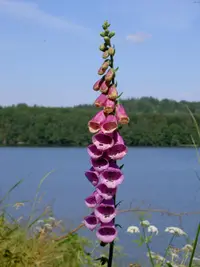
The flowers hang along one side of the stem as tubular, nodding bells, often purple with spotted throats.

Digitalis purpurea Identification

Check Your Plant with Botan

Take or upload a photo to confirm your plant ID with Botan.

Clear images work best. Avoid photos taken too close or too far away

Check the plant’s overall shape, leaves, and flower arrangement first.

  • A tall, single flowering stem rises above a low basal rosette of leaves.
  • Leaves are oval to lance-shaped, softly hairy, and strongly veined, often 4-10 inches (10-25 cm) long.
  • Flowers hang to one side of the upper stem in a long, crowded spike.
  • Each flower is tubular to bell-shaped, about 1.5-2.5 inches (4-6 cm) long, with a wide lower lip.
  • Open flowers usually show spotted markings inside the throat.

Look for the one-sided line of hanging bells combined with the large, fuzzy basal leaves.

Digitalis purpurea shows clear stage-by-stage shape changes that help confirm identification.

  • Seedling: Begins as a low rosette of soft, oval to lance-shaped leaves with a blunt tip, pale veins, and a distinctly downy surface.
  • Young plant: The rosette expands into larger, wrinkled basal leaves, while no upright flowering stem is present yet, keeping the plant broad and ground-hugging.
  • Flowering stage: A tall, mostly unbranched spike rises 3-6 feet (0.9-1.8 m), with alternate stem leaves and one-sided rows of drooping tubular flowers.
  • Fruiting stage: After flowering, the colored tubes are replaced by many small, dry capsules along the same spike, which stays upright and narrow.

Several well-known Foxglove selections can be separated by flower color, flower form, and plant height.

  • 'Alba': Flowers are white rather than the usual purple to pink, with spotted throats still visible inside the tube.
  • 'Apricot': Flowers open soft apricot to peach instead of purple, giving the spike a warm buff tone.
  • 'Camelot Rose': This cultivar bears rose-pink flowers on sturdy stems and is often shorter, around 3 to 4 feet (0.9 to 1.2 m) tall.
  • 'Gloxinioides': Flowers are broader and more outward-facing than typical, with a more open bell shape crowded along the spike.

In spring, Foxglove is often recognized by its low basal rosette, a ground-level circle of soft, wrinkled leaves. By late spring to early summer, a tall upright flower spike becomes the clearest identification feature. After flowering, dry capsule-like seed pods remain along the stem. In winter, the flowering stalk is gone, while the leafy rosette may still be visible in milder areas.

Several tall spired flowers can be mistaken for Foxglove at a glance.

Grecian foxglove(Digitalis grandiflora)

Similar upright spike and basal leaf rosette. It usually has larger, more open yellow flowers, not the longer tubular purple to pink flowers typical of D. purpurea.

Mullein(Verbascum thapsus)

Similar first-year fuzzy rosette and later tall flowering stem. Mullein has a single dense yellow spike with flat, five-petaled flowers, not the hanging bell-shaped flowers along one side of the stem.

Comfrey(Symphytum officinale)

Similar rough leaves and tubular flowers. Comfrey forms branched, drooping flower clusters and broader leaves running down the stem, rather than one tall central spike.

Digitalis purpurea is native to western and southwestern Europe, including the British Isles, Iberia, and parts of western France. This range helps separate it from similar garden foxgloves from southeastern Europe. In the wild, it is most often found in woodland clearings, banks, heaths, and disturbed ground rather than wetlands or alpine sites. Seeing it in those semi-open habitats can support an identification.

  • All parts are toxic: Digitalis purpurea contains cardiac glycosides in the leaves, flowers, seeds, and stems. Ingestion is poisonous to humans and pets.
  • Leaf confusion risk: The basal leaves can be mistaken for comfrey or borage before flowering. Foxglove leaves form a soft, fuzzy rosette and do not have the rough, bristly texture typical of those herbs. Misidentification matters because ingestion is toxic.

Not Sure About the ID?

Botan can identify or verify a plant from a photo, helping avoid mix-ups before you label or buy it.

FAQ

The clearest Foxglove identification feature is the one-sided spike of nodding, tubular bell-shaped flowers, usually purple to pink with spotted throats, rising above a soft basal rosette of gray-green, hairy leaves.

More Plant Identification Guides

Identify It. Learn More About It.

Use Botan to identify a plant from a photo, then get plant details, care information, and safety notes tailored to the result.

Botan app identifying a plant from a photo
What Do Plants Need to Grow – 5 Things Every Greenery Can't Live Without

8 min read · 31 Jul 2026

What Do Plants Need to Grow – 5 Things Every Greenery Can't Live Without

To keep plants healthy and thriving, provide the right balance of light, humidity, nutrients, airflow, and quality soil. This guide covers the essentials of year-round plant care.

Beginner Guides
What Do Plants Need to Grow – 5 Things Every Greenery Can't Live Without
15 Best Scary Halloween Plants and Fungi for a Spooky Garden

8 min read · 9 Oct 2026

15 Best Scary Halloween Plants and Fungi for a Spooky Garden

Want a garden that looks eerie in October? Here are 15 Halloween plants and fungi, from carnivorous traps to bleeding mushrooms. For each species, we cover its appearance, care requirements, and potential uses in your landscape.

Plant Recommendations
15 Best Scary Halloween Plants and Fungi for a Spooky Garden
How to Winterize Your Garden in 6 Steps

5 min read · 28 Sept 2026

How to Winterize Your Garden in 6 Steps

Learn how to prepare your garden for winter with a practical six-step checklist covering cleanup, tender plant care, watering, mulching, winter protection, and winterizing equipment and containers.

Plant Care
How to Winterize Your Garden in 6 Steps