What Is Plant Identification – A Complete Guide
Learn all about the 5 major plant identification methods and choose the one that fits you best. Find out which plant features to focus on, how to simplify the process, and how to avoid the most common ID mistakes.


On this page
- Why Identifying Plants Is Harder Than It Looks
- Key Features for Plant Identification
- 5 Ways to Identify a Plant
- 1. Plant Identification Apps
- 2. Manual Guides and Plant Identification Keys
- 3. Google Lens
- 4. AI Tools
- 5. Plant Forums and Online Communities
- A Comparison of Plant Identification Methods
- 7 Frequent Mistakes in Plant Identification
- How Plant Identification Helps With Care
What is plant identification? This is a systematic process that allows you to identify an unknown plant by matching its characteristics to similar-looking species.
There are a few ways to find the right match. You can do your own research or use one of the tools: instant ID apps like Botan, Google Lens, or Artificial Intelligence. We’ll review each method, so you can choose the one that works best for you.
Why Identifying Plants Is Harder Than It Looks
The number of known plant species is 374,000, and it continues to grow. However, the diversity of flora isn’t the only identification challenge.
Here are a few more variables that can complicate the process:
- Age: juvenile and mature plants of the same species can look completely different.
- Environment: the plant's appearance is largely affected by environmental factors (shade vs. sun, moisture levels, etc.).
- Look-alikes: many species look similar, despite being from different genera.
- Hybrids: a cross between 2 species can be very hard to identify.
- Geography: the same plants can look different across regions.
- Ideal specimen bias: real plants often don’t look like their textbook examples.
Still, these challenges don’t make identification impossible, especially if you rely on a science-based, step-by-step system.

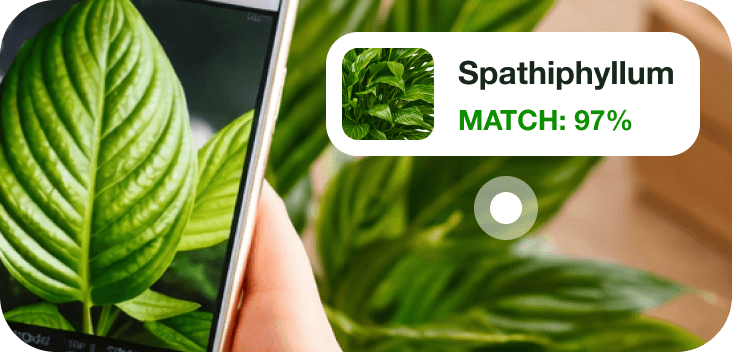
Identify Your Plant
Scan the plant and get a result with 98% accuracy
Key Features for Plant Identification
The identification process should never be random. There are specific features to notice and analyze first:
- Leaves: consider leaf structure (simple or compound), arrangement (alternate, opposite, whorled, etc.), shape (oval, spear-shaped, heart-shaped, etc.), margin (serrate, lobed, entire, etc.).
- Flowers: count the number of petals (3 to 10+), note the flower shape (tubular, star-shaped, bell-shaped, etc.), inflorescence arrangement, and color.
- Stems: consider the growth pattern and texture (green, woody, trailing, climbing, etc.), shape (round, square, triangular), and types of joints.
- Roots (if visible): determine shape and branching pattern (one central root, many thin roots, roots sprouting from stems or leaves), color, and texture.
- Fruit or seeds: notice the type (berry, nut, pome, single-seeded, multiple-seeded, etc.), surface and texture (spiny, waxy, feathery, etc.), color, arrangement on the plant, size, and shape.
- Scent: consider the smell (mint, citrus, onion, garlic, turpentine, bitter, etc.) of flowers, crushed leaves, bark, and roots.
Remember that those elements work together. Evaluating individual characteristics won’t lead you to the correct species — analyzing their combination will.

5 Ways to Identify a Plant
If you’re at the very beginning of your journey, you’ll need some tools and additional information. These might include an app, a guide, or an encyclopedia. The options are many, and we’ll cover the 5 most effective ones.
1. Plant Identification Apps
If you’re asking yourself, “Is there an app for plant identification?” the answer is definitely yes. Such apps are designed to accurately identify species in seconds, provide all necessary information about them, and offer care or treatment advice.
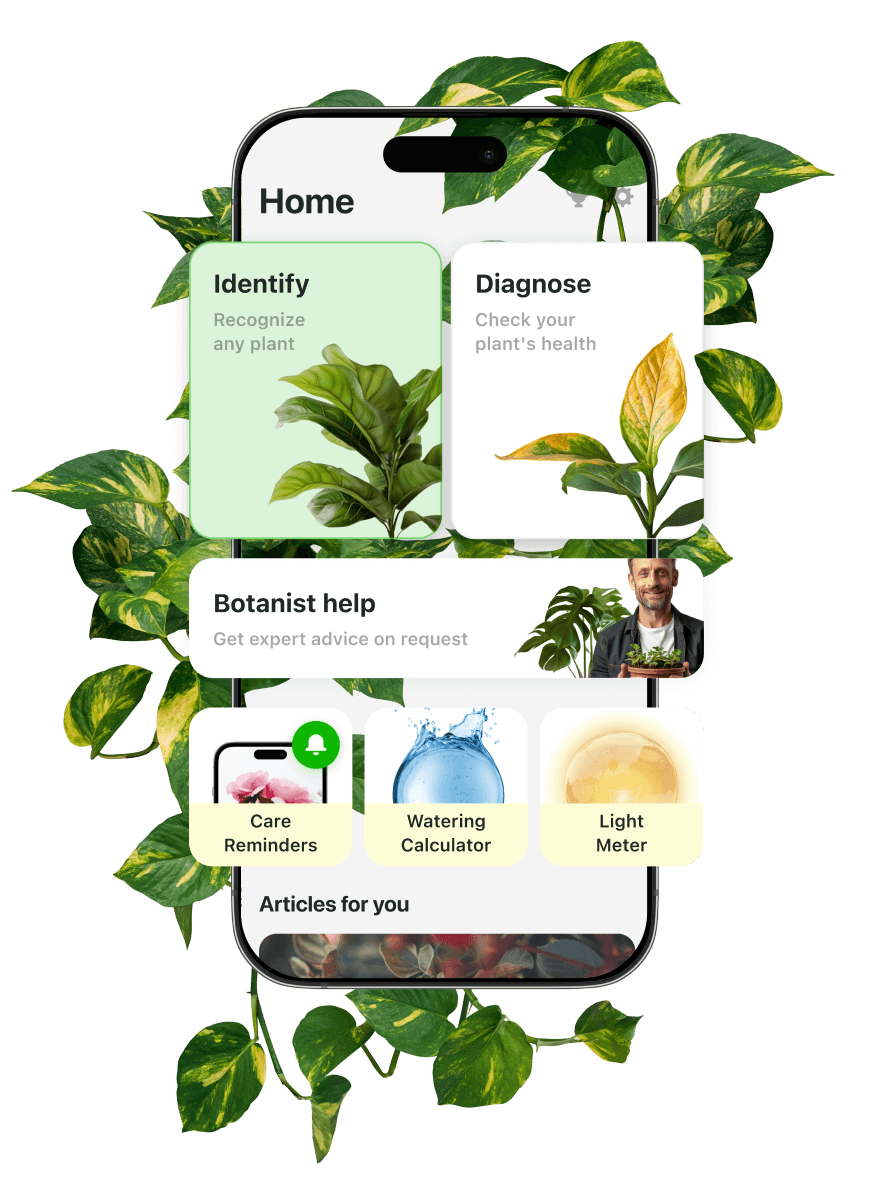
Let’s take Botan as an example. It’s the plant identification app that covers over 30,000 common and rare species. You can upload a photo, wait for the system to find a match by sending an ID request in a cascade, and get your result. Scientific bases and advanced technology allow the app to achieve 98% accuracy.
Test Botan for free to see if it works for you. Try unlimited scans, disease diagnostics, care and treatment guides, and expert consultations.
2. Manual Guides and Plant Identification Keys
Botanical knowledge is readily available online. You can start with plant identification basics and expand your knowledge by reading field guides, botanical books, and articles on the topic.
Also, learn to use dichotomous botanical keys. A plant identification key is basically a series of yes/no questions. Does the plant have leaves? Yes, so move on. Are they simple or compound? Proceed to the leaf edges.
We’d also recommend searching for regional floras from trusted publishers like Princeton University Press or BSBI.
3. Google Lens
Google Lens also offers plant identification by photo, and it's completely free and available on both Android and iOS. It lets you recognize animals and plants, including trees, and shows a high level of accuracy for common species.
Still, you’ll need to interpret the results yourself. They aren’t always reliable, especially when it comes to rare and exotic plants in the area.
4. AI Tools
AI models like Claude, ChatGPT, Gemini, and many others can also analyze images and recognize plants.
Let’s say you want to identify a weed by photo. You only need to take a picture of it and save it to your gallery. Then, open a chat with your model, attach the file, and submit your request.
The key advantage of this method is the opportunity to “communicate”: ask questions, provide context, discuss look-alikes, and, in the end, achieve potentially more accurate results.
5. Plant Forums and Online Communities
Collective specialist knowledge is also available online. You can just ask a question on one of the big niche forums, such as the National Gardening Association or Facebook groups of enthusiasts.
Communication with real professionals and even amateurs often provides accurate results due to active discussion, debate, and the ability to evaluate different experiences and points of view.

A Comparison of Plant Identification Methods
Each ID method has its pros and cons. You only need to set your priorities and choose the option that best fits your needs.
Method | Advantages | Disadvantages | Best For |
Plant ID Apps | High accuracy & speed, convenience, science-based ID, care tips, disease identification, recovery guides, reminders | Apps are usually premium or freemium, need to search for the most effective app | Users seeking the most accurate ID results & advanced care tips |
Educational Materials | Builds genuine botanical knowledge, information is trusted and peer-reviewed | High level of effort and entry barrier, high cost of an error, and very slow | Enthusiasts who want to build botanical literacy and deep expertise over time |
Google Lens | Free, often pre-installed, searches the entire web | Low accuracy, especially for rare plants and hybrids | Casual users who want to discover the flora around them |
AI Tools | Clarifications, broad general knowledge in botany, and reasoning | 30% inaccurate IDs on average, hallucinations, usage limits | Those who want to be able to ask questions & get instant responses |
Forums & Communities | Genuine specialists may reply, room for discussion, multi-angle ID | Completely unpredictable response time, no qualification guarantee, mixed or contradictory opinions | Beginners who prefer expert opinions |
So, each method has its benefits, and you can combine them all to achieve the best results.

7 Frequent Mistakes in Plant Identification
There are a few common mistakes that often prevent beginner botanists and enthusiasts from identifying species correctly:
- Starting with many unrelated species — consider starting with groups of related plants instead to learn the key differences between the genera.
- Relying on a single feature — the shape of the leaf alone can’t be grounds for ID; it’s always the combination of features.
- Focusing too much on color — it’s actually the least reliable feature in botany. Structure matters a lot more.
- Ignoring seasonal or age changes — plants can look completely different in summer or winter, and at different growth stages.
- Confusing different species within one family — for example, grasses like Agrostis, Poa, and Festuca can look nearly identical, so deeper research is needed.
- Rushing too much — there are many look-alikes, so if you analyze 2-3 elements and find a similar picture, it doesn’t always mean that’s the right species.
- Trusting common names — they have many synonyms, sometimes used interchangeably or incorrectly, so always double-check scientific names.
If you’re new to plant ID, consider starting with familiar species. You can move on to rare ones once you feel more confident.
How Plant Identification Helps With Care
Regardless of what you choose, a niche plant identification tool, an AI model, or independent research, the correct ID result will give you the best basis for caring for your plant.
It’s the first necessary step. The next one is learning about the plant’s environmental needs, care specifics, and potential vulnerabilities. You can get pretty much all the information on the plant, from its origin to its toxicity level, and if you use a niche app, you can do it with a single tap.
FAQ
Yes, you can use an app like Botan for instant plant identification. It covers 30,000+ species, from houseplants to rare and exotic ones, and offers many advanced features: disease ID, recovery guides & recovery time estimates, live chat with an expert, and more.
Dariia Plaksina
Botanist
5 years of botanical research experience
Dariia Plaksina is a biologist, botanist, and writer of informational articles with over 5 years of experience exploring the world of plants, nature, and biology. She studied at Taras Shevchenko National University of Kyiv, Educational and Scientific Center “Institute of Biology and Medicine,” where she built a strong scientific foundation for her future work.
For Dariia, writing is a hobby, a calling, and a way to make reliable knowledge easier to understand. Her articles focus on plant care, plant health, and natural processes, helping readers learn more about the living world through clear, accessible, and science-based explanations.
Related Articles
7 min read · 17 Aug 2026
How to Tell If Dragon Fruit Is Ripe – Key Signs of Ripeness
A quick, practical guide to reading dragon fruit ripeness by color, firmness, and wing condition — plus how to pick a good one at the store and ripen an underripe fruit safely at home.

7 min read · 5 Aug 2026
How to Use a Plant Identifier App – Step-by-Step Guide
Learn how to get the most out of a plant identifier app. Here, you’ll find direct instructions on how to use the app and take the right photos, a list of common mistakes to avoid, and bonus tips for evaluating the app’s features.
8 min read · 1 Oct 2026
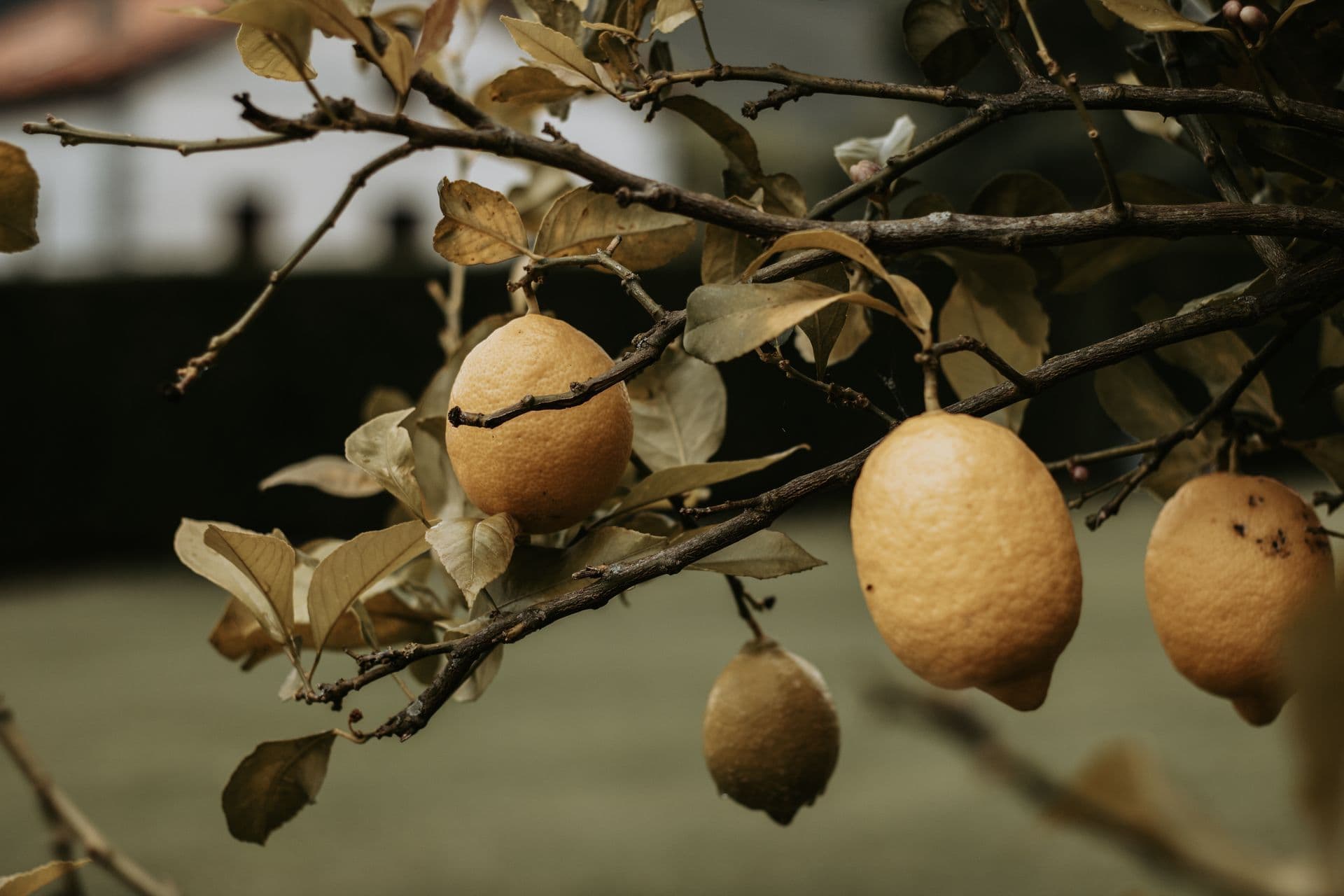
Lemon Tree Leaves Turning Yellow: Causes and How to Fix It
Yellow leaves are one of the most common lemon tree problems. This guide explains eight causes of lemon tree leaves turning yellow, from overwatering to root rot, with a fix for each.
Explore Plants by Care Needs
 POPULAR
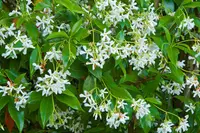
Star jasmine
Trachelospermum jasminoides
 POPULAR
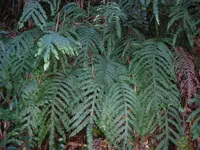
Blue star fern
Phlebodium aureum
 POPULAR
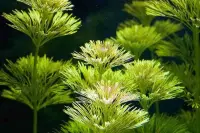
Asian marshweed
Limnophila sessiliflora
 POPULAR
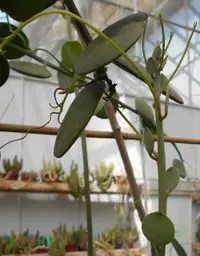
Silver Dollar Vine
Xerosicyos danguyi
 POPULAR
Rice cactus
Rhipsalis cereuscula
 POPULAR
Spiny pincushion cactus
Mammillaria spinosissima
 POPULAR
Fire-star orchid
Epidendrum radicans
 POPULAR
Foxtail Agave
Agave attenuata
Identify the plant and problem. Help your plant recover
Identify plant problems early, understand what's wrong, and get clear care guidance. Botan helps you turn guesswork into confident plant care