Why Rose Leaves Turn Yellow and How to Fix That
Yellow leaves on roses can result from water stress, unfavorable environmental conditions, nutrient deficiencies, or infections. Learn what caused the symptom and adjust care with expert tips.

On this page
- Main Reasons Why Rose Leaves Turn Yellow
- Yellow Rose Leaves Symptoms and What They Mean
- Watering Problems and Root Stress
- Overwatering and Poor Drainage
- Underwatering and Drought Stress
- Lack of Nutrients
- Rose Diseases That Turn Leaves Yellow
- Black Spot Disease
- Other Fungal & Virus Leaf Diseases
- Pests That Can Cause Yellow Rose Leaves
- Environmental Causes of Yellow Rose Leaves
- How to Help a Rose Recover
Roses are some of the most resilient plants. Still, they aren’t immune to damage. Yellow leaves on roses indicate one thing — the plant is under stress. This can be due to different factors, from fungal diseases and nutrient deficiencies to improper watering.
You can learn the exact cause from the main and additional symptoms, and we’ll tell you how. Read on to quickly identify the problem and get rid of it easily.

Main Reasons Why Rose Leaves Turn Yellow
There are two categories of triggers that can cause this specific symptom: nonliving factors and living organisms.
Nonliving factors include:
- Overwatering
- Underwatering/drought
- Nutrient deficiency
- Unfavorable temperature
- Chemicals
Organisms triggering the symptom include:
- Fungal diseases
- Viruses
- Pests
These categories might seem completely different. However, when you notice yellow leaves on a rose bush, it always means that a certain external condition disrupts the plant’s metabolism and growth. The good news is that in most cases, your rose can fully recover.
You’ll need to remove the negative factors, apply treatment, and then get your plant back to normal.

Your Personalized Care Plan
Get personalized plant care recommendations in the app
Yellow Rose Leaves Symptoms and What They Mean
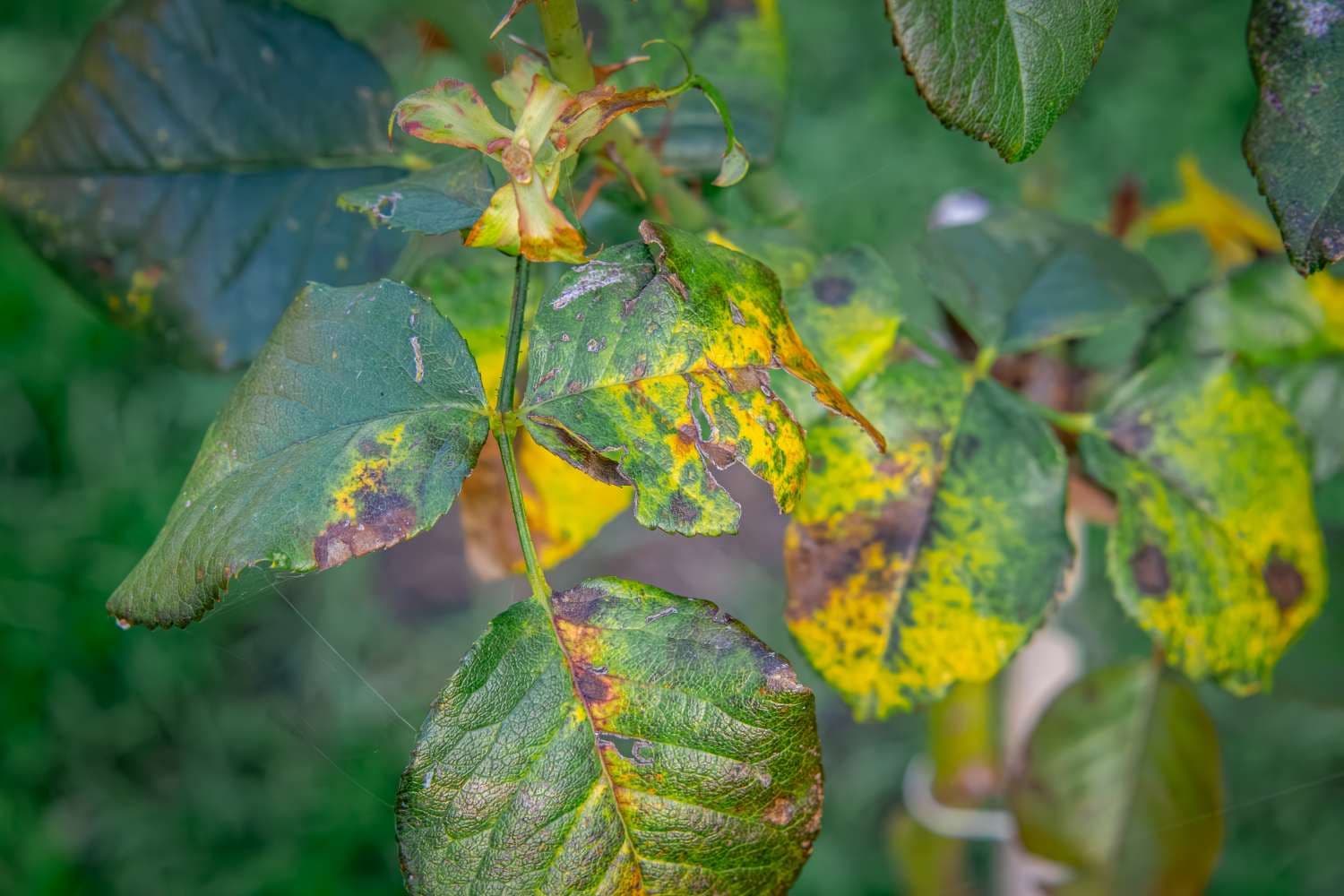
Rose bush leaves turning yellow may look quite similar at a distance. However, if you take a closer look at the spots, lines, patterns, or texture of the damaged parts, you can identify the cause.
What You See | Possible Causes |
Dry, crispy, yellow leaves with brown tips | Underwatering, drought |
Soft, limp leaves that yellow entirely | Overwatering, root rot |
Dark spots with feathery edges on the yellowing leaves | Black spot disease |
Yellow spots on the upper surface, matching orange spots beneath | Rose rust disease |
Yellow lines, rings, zigzags, or oak-like banding | Rose mosaic disease |
Tiny yellow dots on the upper leaf surface (stippling) and dusty webbing on the underside | Spider mites |
Yellowing, curling leaves with honeydew | Aphids or scale insects |
“Eaten” yellowing leaves with veins untouched | Rose sawflies (roseslugs) |
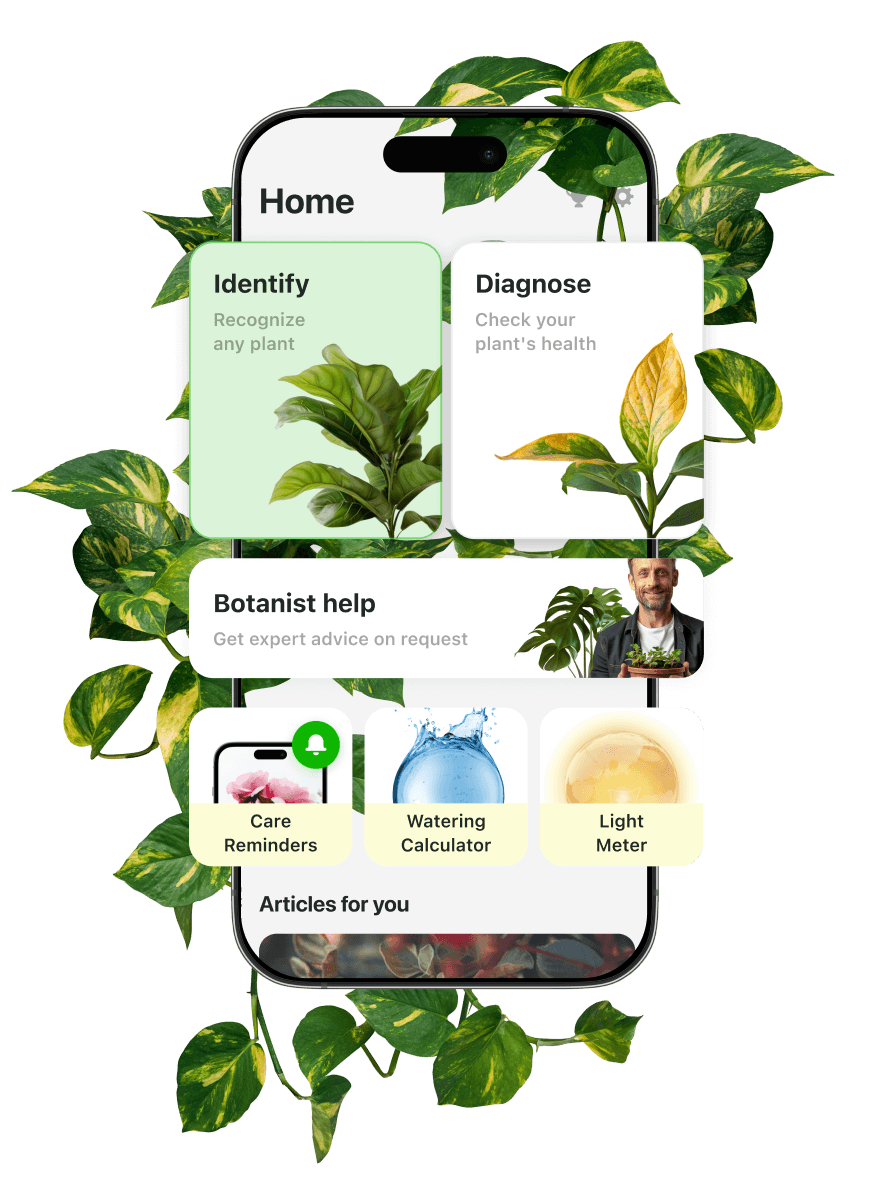
Recognizing the issue correctly will require patience and some extra research. If you want to simplify the process, you can use the Botan app — a system designed to identify problems and develop custom solutions.
Just take a photo of damaged rose leaves and let the scanner process it. That’s how you can get a diagnosis in 1-3 seconds, receive step-by-step instructions for treating the plant, and take action immediately.
Watering Problems and Root Stress
A rose plant with yellow leaves often signals water stress. It might seem like a relatively innocent factor compared to viruses or infections, but it can still seriously damage the bush.
In particular, prolonged underwatering causes drought stress, affecting both flowers and leaves. Overwatering, in turn, can result in root rot and infections.
So, let’s take a closer look at the two most common problematic scenarios, their symptoms, and the mechanisms behind yellowing leaves.
Overwatering and Poor Drainage
Roses are relatively heavy drinkers, which makes them easy to overwater. However, excessive moisture doesn’t give them excessive energy. It prevents the plant from getting enough oxygen instead.
The oxygen deprivation, in turn, causes cell death. Roses get vulnerable to pathogens, and fungi often move in. They are drawn to damaged root tissue and begin spreading throughout the roots. In the end, this seriously damages the system that transports nutrients, and leaves start to turn yellow, get soft, and wilt.
Also, pay attention to the roots. If overwatering is the problem, you’ll notice that they get mushy and develop a foul odor.
Underwatering and Drought Stress
If you notice lower rose leaves turning yellow, it’s likely a sign of underwatering. In such circumstances, a plant experiences drought stress and tries to reduce water loss at all costs.
It starts to decrease photosynthesis and redirects nitrogen to younger leaves. Simply put, it cannibalizes some of its old leaves to support fresh growth.
Use a moisture meter to check if the soil is dry 3-4 inches down. If that's the case and you notice older leaves becoming dry and crispy with brown tips, underwatering is the most likely issue.

Lack of Nutrients
Roses are heavy feeders, too. Some of the nutrients they need most are:
- Nitrogen — leaves turn from pale green to yellow, curling down.
- Phosphorus — growth slows down, and leaves turn pale and small (yellow color can dominate when combined with the deficiency of other nutrients, or appear on the leaf edges).
- Potassium — fresh leaves are yellow instead of dark red; may develop reddish-brown spots.
- Calcium — mature leaves become pale green to yellow with darkened tips and edges.
- Magnesium — leaves lose gloss and color between the veins, get weaker, and may develop oval rings on leaflets.
Note that the soil often has all the necessary nutrients, but they are “locked up” due to a pH outside the 6-7 range. The problem remains the same, and so do the symptoms. However, in this case, using elemental sulfur (to lower pH) or a liming agent (to raise pH) will be more effective than simply adding a standard rose fertilizer.
Rose Diseases That Turn Leaves Yellow
Sometimes, yellow leaves are caused by pathogens — most often fungi, but sometimes viruses. Fungal diseases are common in roses and are more of a maintenance problem. The yellow leaves and spots won't go away on their own, but the disease itself can be treated. Viral diseases, on the other hand, are rare, but they have no treatment.
Black Spot Disease
Black spot, also known as Diplocarpon rosae, is the most common and the most damaging yet treatable fungal disease in roses.
It’s spread by spores from overwintered leaves and stems, typically via rain or splashes from watering. Germination starts under favorable conditions: high moisture and temperatures between 75°F and 85°F (24°C and 30°C).
As the infection takes hold, the plant weakens, and symptoms begin to appear. That’s when you see dark black or slightly purplish spots with feathery edges on the leaves.
Spots often have yellow halos, and the entire leaf surface starts yellowing, too. In most cases, lower leaves get affected first. Also, you may notice red spots on flower petals.

Other Fungal & Virus Leaf Diseases
Other infections that may affect roses include:
- Rose rust (fungal) — yellow spots on the upper surface, matching bright orange spots on the undersides of leaves.
- Downy mildew (fungal) — angular spots “trapped” in leaf veins, turning from pale green to yellow and then to red or brown.
- Rose mosaic (virus) — yellow lines, rings, zigzags, or banding looking like an oak leaf.
Unlike fungal diseases that spread through spores, viral infections spread from infected plants — directly or via eriophyid mites.
In any case, symptoms are very distinctive, so you’ll hardly confuse them with the signs of overwatering or another type of environmental damage.
Pests That Can Cause Yellow Rose Leaves
Sometimes, the problem is pests, and here are the insects that damage roses most frequently:
- Spider mites. These are tiny arachnids that thrive in dry, hot weather. You can hardly see them without a hand lens, but they leave signs — tiny yellow dots across the upper leaf surface and dusty web on the underside. Look for stippling and discoloration to identify them.
- Aphids. Unlike mites, aphids are visible. These are tiny green, pink, or black insects feeding on plant sap. They cause nutrient and moisture loss, leading to slower growth and yellowing or curling of leaves. They also leave behind honeydew.
- Scale insects. Mature scale insects look like immobile, crusty bumps on stems and undersides of leaves. Like aphids, they feed on sap and produce honeydew, which causes yellowing or wilting of leaves. However, they also leave white scale — small white circles or waxy patches on canes.
- Rose sawflies (roseslugs). These insects eat the soft parts of leaves, ignoring the veins and leaving yellow-to-brown tissue that slowly dries out. The damage is rather cosmetic, and the plant easily recovers after you apply insecticidal soap.
As you can see, the problem with pests is often not the physical damage itself. In the cases of mites, aphids, and scale insects, they just “rob” the plant, getting its sap and nutrients.

Environmental Causes of Yellow Rose Leaves
As we noted before, sometimes the stress is caused by purely environmental factors, such as:
- Heat — causes a lack of moisture, high soil temperatures
- Frost — damages cells and prevents normal water absorption
- Transplant shock — difficulty adjusting to new soil chemistry
- Chemical burns — often caused by excessive fertilization
- Poor drainage — causes a “bathtub” effect
These problems are very rarely fatal. If the initial cause is fixed, your roses will likely recover quite rapidly.
How to Help a Rose Recover
To cope with the problem and prevent it in the future, follow these simple recommendations:
- Adjust watering: When the top 2-3 inches of soil are dry, water in the morning, at the base only.
- Test the soil pH: Keep it at 6.0-7.0 so nutrients stay absorbable.
- Check the roots: Unearth them to see whether they are light and firm or mushy and black (fungal infection or root rot).
- Feed on a schedule: Every 4-6 weeks during the growing season.
- Inspect for pests weekly: If you spot any signs, apply the appropriate insecticide or a DIY solution.
- Mulch the base: Use 2-3 inches of organic mulch.
- Clean weekly: Remove fallen leaves to prevent the spread of infections.
Also, consider choosing disease-resistant varieties such as beach rose, Belinda’s Dream, the Knock Out series, and others.
FAQ
It may be overwatering or underwatering. If they are dry and crispy, it might be a lack of moisture. If they are soft and mushy and the roots are dark and foul, it’s likely due to excessive moisture.
Dariia Plaksina
Botanist
5 years of botanical research experience
Dariia Plaksina is a biologist, botanist, and writer of informational articles with over 5 years of experience exploring the world of plants, nature, and biology. She studied at Taras Shevchenko National University of Kyiv, Educational and Scientific Center “Institute of Biology and Medicine,” where she built a strong scientific foundation for her future work.
For Dariia, writing is a hobby, a calling, and a way to make reliable knowledge easier to understand. Her articles focus on plant care, plant health, and natural processes, helping readers learn more about the living world through clear, accessible, and science-based explanations.
Related Articles
8 min read · 1 Oct 2026
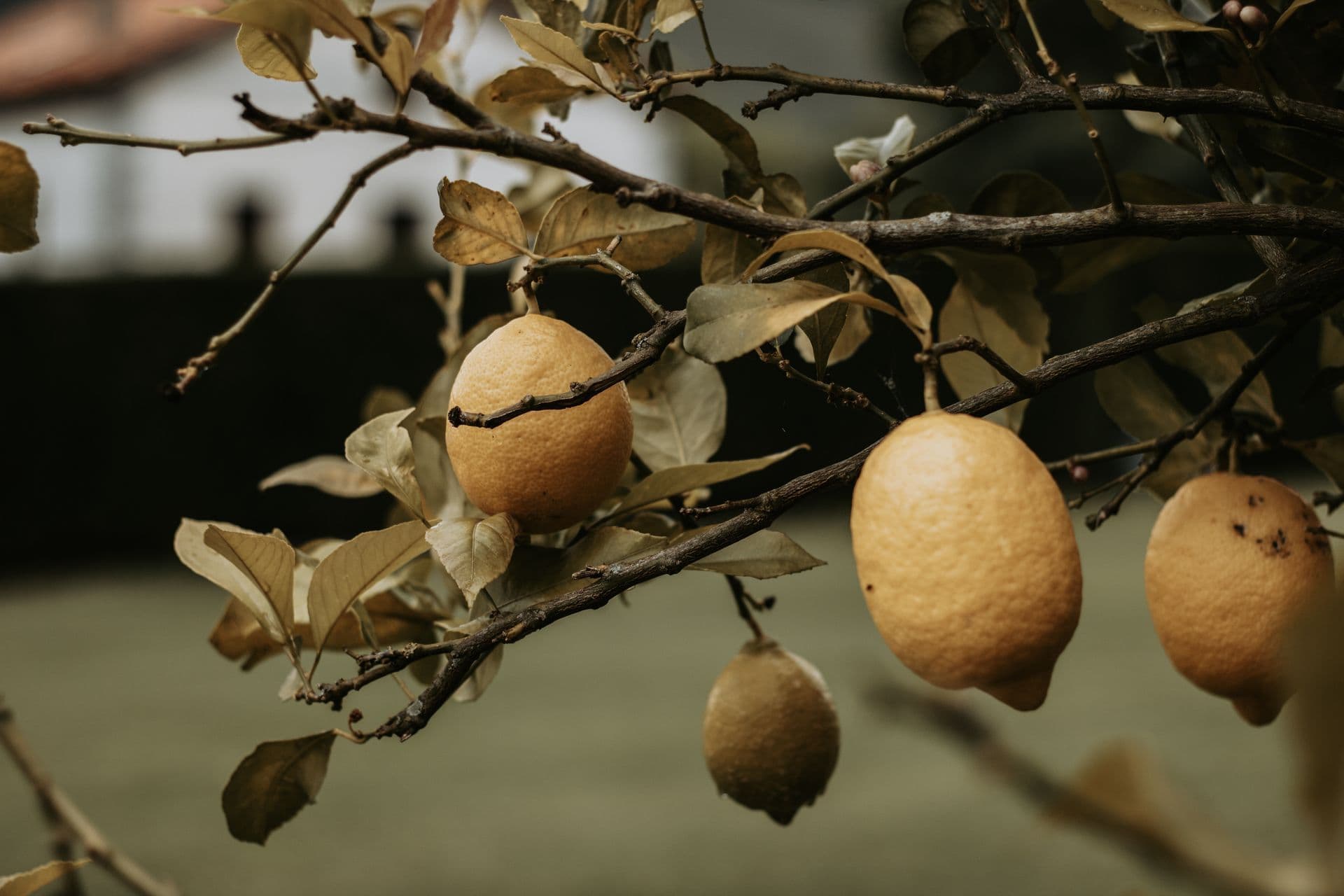
Lemon Tree Leaves Turning Yellow: Causes and How to Fix It
Yellow leaves are one of the most common lemon tree problems. This guide explains eight causes of lemon tree leaves turning yellow, from overwatering to root rot, with a fix for each.

5 min read · 16 Sept 2026
How to Keep Cats Away From Plants: 7 Safe and Effective Methods
Cats may dig in potting soil, chew leaves, or knock containers over. These seven methods combine safer placement, physical protection, a suitable chewing alternative, and play to help protect your plants without putting your cat at risk.
5 min read · 7 Sept 2026
Overwatering vs Underwatering: How to Tell the Difference
Overwatering and underwatering can look almost identical, so they're easy to confuse. In this guide, we'll cover the signs of each, simple ways to tell them apart, and how to treat your plant once you know what's wrong.
Explore Plants by Care Needs
Identify the plant and problem. Help your plant recover
Identify plant problems early, understand what's wrong, and get clear care guidance. Botan helps you turn guesswork into confident plant care