Christmas Cactus vs Thanksgiving Cactus: How to Tell Them Apart
Christmas and Thanksgiving cacti look remarkably similar, but their stem shapes, flowers, and blooming seasons reveal important differences.


On this page
- Thanksgiving Cactus vs Christmas Cactus at a Glance
- How to Tell Christmas Cactus from Thanksgiving Cactus
- Leaves (Stem Segments): Pointed Claws vs Rounded Scallops
- Flowers: Angle, Shape, and Anther Color
- Bloom Time
- Growth Habit
- Is Your “Christmas Cactus” Really a Thanksgiving Cactus?
- Where Does the Easter Cactus Fit In?
- Do Christmas and Thanksgiving Cacti Need Different Care?
- How to Make Your Holiday Cactus Bloom on Time
- Christmas or Thanksgiving Cactus: Which One Should You Choose?
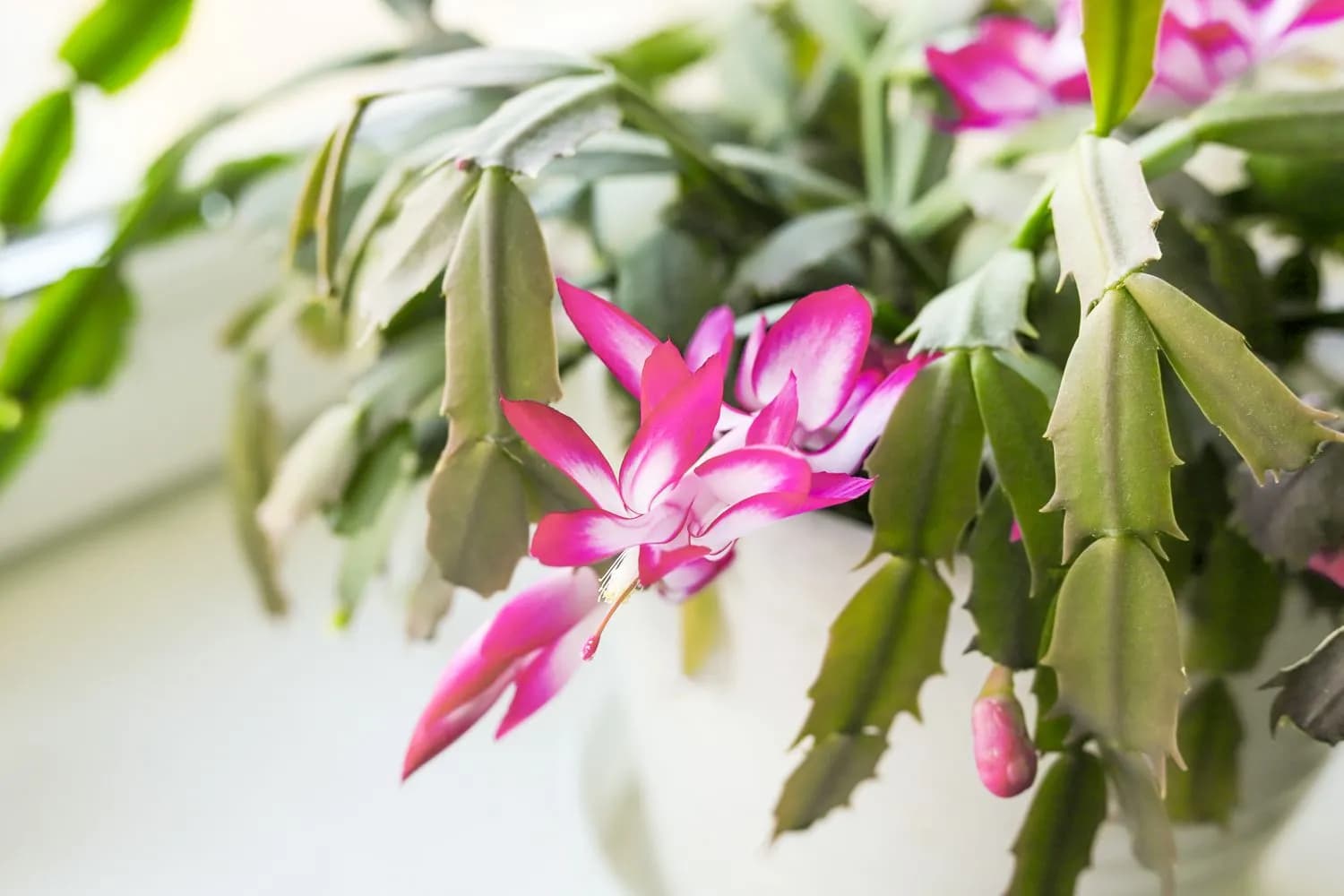
The holiday season is coming, and it's easy to confuse two festive favorites: Christmas cactus vs. Thanksgiving cactus. So, how can you tell them apart? The easiest clue is stem shape: Thanksgiving cactus has pointed edges, while Christmas cactus has rounded ones.
This Botan App guide explains how to identify both species and encourage healthy, timely blooms each year.
Thanksgiving Cactus vs Christmas Cactus at a Glance
Both festive houseplants are not typical desert cacti with thick stems and sharp spines. These plants, belonging to the genus Schlumbergera, native to humid tropical Brazilian forests, have flattened, segmented green stems without prominent spines.
The main difference between Christmas and Thanksgiving cactus involves stem shape, flower structure, growth habit, and blooming season:
Feature | Thanksgiving Cactus (Schlumbergera truncata) | Christmas Cactus (Schlumbergera × buckleyi) |
Leaves (stem segment edges) | 2-4 pointed, claw-like or teeth-like edges | Rounded, scalloped edges with soft bristles |
Flower shape | Asymmetrical tubular flowers | More symmetrical, drooping tubular flowers |
Flower position | More horizontal | Usually hangs downward |
Anther color | Yellow | Purplish-brown |
Typical blooming time | November-December | December – January |
Growth habit | More upright when young, later arching bush-like | Can be upright, pendulous, or trailing |
How common in stores | Very common | Less common |
Identify Your Plant
Scan the plant and get a result with 98% accuracy
How to Tell Christmas Cactus from Thanksgiving Cactus
The easiest way to identify these houseplants is to examine their stems, as they are one of the most visible clues, even when a plant isn’t flowering. Understanding how to tell Christmas cactus from Thanksgiving cactus involves comparing segment edges, flowers, bloom time, and growth habit together.

Leaves (Stem Segments): Pointed Claws vs Rounded Scallops
Although parts of these succulents look like leaves, the green structures on both plants are flattened stem segments called cladodes. Photosynthesis occurs primarily in these modified stems.
The Thanksgiving plant has 2-4 broad, pointed projections on stem margins, resembling small teeth or claws. This distinctive shape explains its common name, crab cactus.
When comparing pictures of Christmas cactus, you can notice scalloped or teardrop-shaped leaf projections with a glossy surface and clusters of soft bristles on the ends.
If you see unfamiliar holiday greenery at a garden center or plant nursery, focusing on its stem segments, along with running its photo through the cactus identifier, can help identify its species.
Flowers: Angle, Shape, and Anther Color
Both cacti produce colorful tubular flowers, but their position and anther colors differ. Thanksgiving succulent flowers usually extend or angle horizontally upward. Their petals form an arching downward asymmetrical shape, with the flower tube appearing slightly bent near its base.
This succulent typically has yellow anthers – the structures that produce and release pollen. It is commonly found in creamy white, red, pink, orange, and purple colors.
Christmas succulent flowers generally hang downward from the segment tips. Their structure is less sharply angled and often appears more symmetrical. Their anthers are purplish-brown, while petals are purplish-red, pink, or white.

Bloom Time
Both cacti bloom during the seasonal holidays that their names correspond to. The Thanksgiving greenery generally begins blooming in November, while the true Christmas plant opens its buds from December to January.
These are short-day plant types, meaning 14 hours of darkness and cooler temperatures help initiate flowering. However, bloom time isn't a definitive identification method. Indoor lighting, temperature, and commercial greenhouse practices can shift flowering dates.
A Thanksgiving plant exposed to different growing conditions may bloom around Christmas, while a Christmas species can flower earlier than expected.
Growth Habit
Thanksgiving succulent often develops a more upright, branching, bushy-like appearance when young. Its stems gradually arch outward as they lengthen, creating a spreading or cascading shape.
Christmas cactus typically has more noticeably drooping branches, particularly in mature specimens. Its flexible segments form long, trailing stems suitable for hanging baskets.
Both festive plants are naturally epiphytic. In the wild, they grow on trees or among rocks. However, cultivated species successfully thrive in home pots with well-drained soil.
Not sure which succulent you see?
Scan the plant and explore its care needs
Is Your “Christmas Cactus” Really a Thanksgiving Cactus?
Many plants marked as Christmas cacti in the stores are actually Thanksgiving cacti or hybrids with similar characteristics. The reason for such misidentification is largely commercial.
Since Thanksgiving cacti typically bloom earlier than true Christmas cacti, they are specifically cultivated for the fall and winter holiday market. Commercial growers can also control flowering time by adjusting greenhouse temperatures and lighting. As a result, retailers frequently use the familiar name “Christmas cactus” for several closely related varieties.
Thanksgiving plant is also known as the false Christmas cactus, an established common name for Schlumbergera truncata because it resembles the true Christmas type, which causes frequent confusion.
So, is there a Thanksgiving cactus? Yes. Schlumbergera truncata is a distinct species, while the traditional Christmas cactus, Schlumbergera × buckleyi, is a hybrid involving S. truncata and S. russelliana.
Where Does the Easter Cactus Fit In?
The third popular holiday succulent is the Easter cactus, with the botanical name Rhipsalidopsis gaertneri. This houseplant has the following three holiday cactus differences:
- Stem shape: rounded, spineless segments with shallow ripples and tiny soft bristles near the tips.
- Flowers: more symmetrical, star-shaped blooms rather than elongated, angled tubes.
- Bloom time: primarily late March through May, rather than late fall or winter.
It usually requires a different seasonal temperature pattern to encourage flowering. Its spring blooming season makes it relatively easy to distinguish from the other two varieties.

Do Christmas and Thanksgiving Cacti Need Different Care?
Unlike desert species, forest-dwelling Christmas and Thanksgiving cactі prefer filtered sunlight, moderate moisture, and well-draining soil.
The table below compares light, soil, temperature, and other requirements, including how often to water a Thanksgiving cactus.
Care Factor | Thanksgiving Cactus | Christmas Cactus |
Light | Bright light in the winter and diffused sunlight or partial shade in summer. Avoid direct sunlight to prevent stem yellowing. | Bright, indirect sunlight. Can thrive in a room with direct sunlight. |
Watering | When the soil is dry to the touch, about once every other week. Avoid overwatering to prevent root rot. | When the soil is almost dry, about every 1-2 weeks. |
Soil | Moist, well-drained potting mix rich in organic matter. | Moist, well-draining mix with sand or perlite for good drainage. |
Humidity | High | High |
Temperature | Around 70-80 °F (21-27 °C) | Around 70-80 °F (21-27°C) |
Fertilizer | Feed the plant once a week during spring with a standard fertilizer mix that contains trace elements. | Use diluted balanced fertilizer during active growth, namely in the spring. |
How to Make Your Holiday Cactus Bloom on Time
To make your plant bloom in time for the holidays, you'll need to make some environmental adjustments. Follow these four steps to support reliable bud set:
- Step 1: Choose the right time. Begin preparing Thanksgiving options around early to mid-September. For Christmas species, begin 3-4 weeks later.
- Step 2: Provide long nights. Give plants approximately 14 hours of uninterrupted darkness daily for 6 weeks. Avoid artificial lighting during the dark period.
- Step 3: Maintain cool temperatures. Aim for nighttime temperatures around 55–65°F (13-18°C). Stand plants away from heaters and areas with sudden temperature changes.
- Step 4: Protect developing buds. Once buds appear, maintain consistent light, temperature, and soil moisture. Avoid unnecessary relocation or repotting.
Following these steps helps your holiday cactus develop healthy buds. If flowering is delayed, check whether the temperature has fluctuated and the lighting conditions have changed.
Christmas or Thanksgiving Cactus: Which One Should You Choose?
If you're wondering what to choose for your home, Christmas or Thanksgiving cactus, consider the preferred flowering season. If you want to see a beautiful combination of green and white or red colors earlier, a Thanksgiving succulent is a suitable choice that is easy to find in stores. Do you prefer later winter flowers with a more trailing growth habit? Pay attention to Christmas species.
If you have a cat or a dog, both mentioned festive succulents are pet-safe plants, so you can calmly buy the desired cacti.
FAQ
Thanksgiving cactus (Schlumbergera truncata), Christmas cactus (Schlumbergera × buckleyi), and Easter cactus (Rhipsalidopsis gaertneri) are three holiday succulents. Their common names reflect their typical flowering seasons in the Northern Hemisphere.
Found this helpful?
Add Botan as a preferred source on Google.
Svitlana Shramenko
Botany Enthusiast
11+ years of experience in texts writing
Svitlana is passionate about the plant world and skillfully combines this interest with science-based botanical writing. She creates engaging, informative articles for both beginner gardeners and experienced plant enthusiasts, helping them better understand the plants around them, maintain their health, and provide proper care.
Related Articles
3 min read · 13 Nov 2026
15 Best Indoor Plants for Your Home
Every plant lover has a small graveyard behind them. Here is the twist... most of those plants did not die from bad care.
8 min read · 6 Nov 2026
8 Glow-in-the-Dark Plants and Fungi That Really Exist
Plants that glow in the dusk really exist. Some of them produce their own light, while others need UV exposure or special treatments. Explore eight fascinating examples, including glowing petunias, bioluminescent mushrooms, fluorescent flowers, and experimental succulents.
4 min read · 20 Oct 2026
When to Harvest Tomatillos: How to Tell When They're Ripe
Tomatillos grow inside papery husks, making it hard to judge ripeness at a glance. This guide explains how to know when tomatillos are ripe and offers practical advice on harvesting and storage.
Explore More Cacti
Mammillaria polythele
Mammillaria polythele
Easter lily cactus
Echinopsis oxygona
Dwarf Chin Cactus
Gymnocalycium baldianum
Ric Rac cactus
Selenicereus anthonyanus
Balloon cactus
Parodia magnifica
Mammillaria zeilmanniana
Mammillaria zeilmanniana
beavertail pricklypear
Opuntia basilaris

kingcup cactus
Echinocereus triglochidiatus
Identify the plant and problem. Help your plant recover
Identify plant problems early, understand what's wrong, and get clear care guidance. Botan helps you turn guesswork into confident plant care