How Botan Identifies Plants
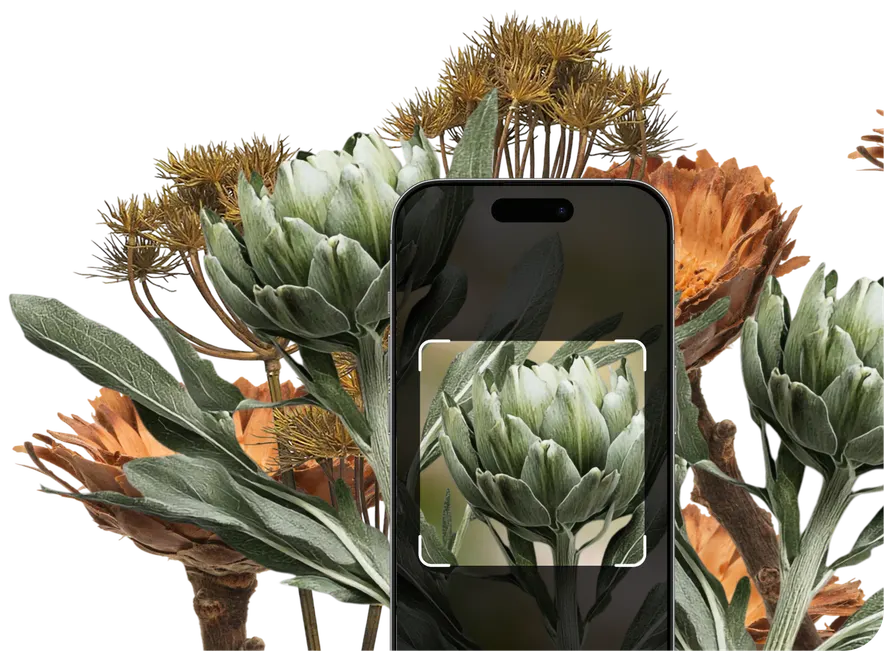
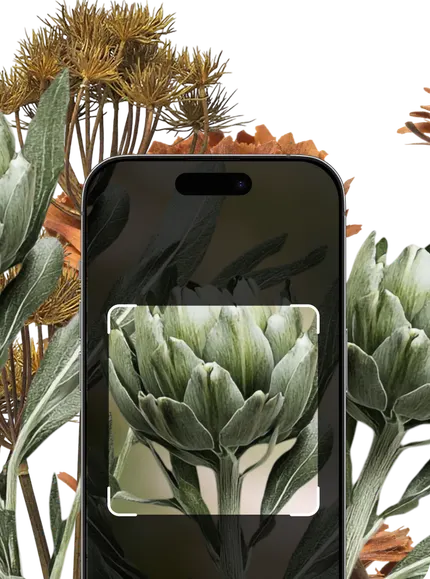
Using the Botan scanner, you can find out what flowers are green or brown and identify unfamiliar flowers. The whole process takes less than a minute:
- Upload a photo of the plant. You can use your camera or gallery.
- Then, Botan scans the photo for visual markers, including all the nuances of the plant’s shape, petals, color, and leaves.
- Next, visual data is compared against a species database containing over 30,000 plants.
- Additional AI scanning helps distinguish plants with similar characteristics.
- The app shows you the species ID and key details.
- If the result is still unclear, upload a new photo. For example, from another angle or in more natural lighting.
Botan’s plant detector works in a fully automatic mode. All that is required is a photo of green and brown flowers and a few seconds of waiting.
What You Should Know About Flower Identification
Brown and green flowers can be difficult to recognize, as they often blend in with the leaves, and this makes them easy to overlook. Their shape also varies, from rounded and drooping to clustered in dense groups.
A good way to understand what green flowers and brown varieties look like is to focus on several features, such as petal and leaf shape, as well as stem structure.
For clarity, the table below illustrates how plant recognition works:
Petal Shapes and Counts
The easiest way to identify a bloom is by its petals. Plants from the same family usually have similar shapes and petal layouts.
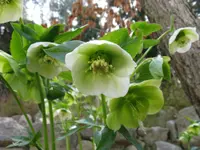
- Round or cup-shaped. These are blooms that form a bowl or shallow cup with smooth petals. Green hellebore and, for example, some roses look like this.
- Tubular. The petals form a tube that either droops downward or extends outward. This shape is often found in foxglove varieties.
- Star-shaped. The petals (five or more) form a flat, open bloom. It is typical of chickweed or some types of borage.
- Daisy-like. A central disk, surrounded by petals. This shape is characteristic of brown-centered coneflowers, often found in meadows.
- Irregular or asymmetrical. An uneven shape where one side differs from the other. It appears in certain orchids and snapdragons.
By identifying the petal shape using this classification, you can try to determine the species. However, the stem and leaves are also essential for accurate identification.
Stem
Stems seem the same across different blooms, but they can help identify a plant when petals are not enough.
Some of them are hollow, which you can notice by gently squeezing them. This is typical of dock-type and elder plants. In contrast, hellebore or amaranth more often have solid stems.
The surface texture can also help suggest the plant’s name. Stems covered with fine hairs are a reliable sign of some dock-type flowers, as well as borage. If the stem is smooth, it may indicate foxglove or, again, amaranth.
Finally, the way a plant grows also matters. While foxglove typically has a single tall, upright stem, sweet scabious produces multiple stems. Each of them carries plants of varying lengths.
Leaves
Sometimes, when a plant is not in bloom yet, the leaves are the most visible and informative part.
- Oval. Smooth, oval-shaped leaves are common among garden and woodland flowers.
- Rounded lobes. Soft, rounded leaf edges are often a sign of lady's mantle and some geranium species. These plants can have muted tones.
- Compound. A leaf may be made up of several smaller parts. For example, meadow rue has small, greenish blooms.
- Heart-shaped. As the name suggests, these are fairly wide leaves. Yellow foxglove is a good example.
- Long and narrow. They often look like straps and grow along the stem, which is typical of certain plantain species or amaranth.
If you are not sure what flowers are brown, these small details will help with identification.
With Botan, you do not need to keep all of the above in mind. While trees or larger plants are relatively easy to identify, the same cannot be said for blooms in these muted tones. Botan’s scanner analyzes all key features by photo with 98% accuracy.
And that is not all. Botan also provides reliable care recommendations tailored to each plant’s characteristics. There is no need to search across multiple sources, as it uses a unified plant database.
In addition, we offer other features such as recommendations for measuring light levels, soil moisture monitoring, and disease detection and treatment to provide proper plant care.



_(49532732922)-2-200x133.webp)